Hip flexors are the group of muscles at the front of your hip that lift your knee toward your chest. You use them every time you walk, climb stairs or stand up from a chair, which is why they get so little rest and so easily end up tight. This page covers where they sit, what they are for, why they grip, and how to tell whether yours are short.
If it is a sharp pinch you are dealing with rather than a general stiffness, that is usually a different problem, and why the front of your hip pinches covers it separately.
Where the hip flexors are
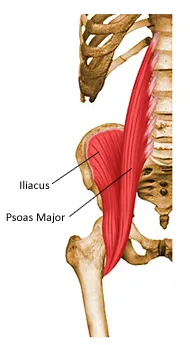
They sit deep at the very front of your hip, out of sight and often out of mind. Visual pictures help with locating deep tissue you cannot see, which is why this comes up so often in our Pilates classes when we work on front hip strength and stability.
Two of them matter most.
Iliacus is the smaller of the two and the more interesting one. Its main job is not to move your leg but to hold the top of your thigh bone, the femur, securely in the hip socket while the bigger muscles get on with moving you around. It is one of the muscles giving that ball-and-socket joint a nice tight fit.
Psoas major is the stronger of the pair. It attaches to your spine as well as your leg, which is why a tight one so often shows up as an ache in your lower back rather than in your hip.
A third, rectus femoris, crosses both the hip and the knee. Technically a quadriceps muscle, but it bends your hip, so it joins in whenever hip flexors are the problem.
What they actually do
“Imagine standing on eggshells and your thigh sinking back into your hip.”
That is the instruction we use to activate the iliacus. You can see the muscle in the image above. As it contracts and shortens, it draws the femur up into the pelvis and holds it there, which is what keeps the joint centred while you move.
Look at the iliacus in the picture and it is easy to imagine it sucking the leg bone up into the pelvis as it shortens. Hence the cue.
So when we do squats, lunges and mat work, the instruction is to picture your iliacus gently drawing your femur into your pelvis for a happier, healthier hip. You will often feel very little happening, and quite often that is the goal.
Subtle. Less is more.
The job sounds small, but it happens thousands of times a day. Every step, every stand, every stair.
Why they grip
Two forces do most of the damage, and they compound.
Sitting. It puts your hip flexors in a shortened position for hours at a time. Your brain starts treating that as normal. When you stand up, the muscles resist lengthening, so they adaptively shorten. This is the single biggest reason hip flexors get stuck, and it has nothing to do with how fit you are.
Thirty to sixty minutes of running does not undo eight to ten hours of sitting. Your hips do not care about your weekly mileage if the rest of your day is chair-bound.
Running and cycling. Both put the hip through repeated flexion without ever taking it to the end of its range. Over time the muscle loses length it is not being asked for.
When hip flexors are tight, they pull your pelvis into a forward tilt, as if you are spilling water out of the front of a bucket. That sets off a chain reaction: your lower back arches and gets compressed, your glutes get stretched and inhibited so they stop firing, your stride shortens, and your knee tracking suffers.
Tight hip flexors rarely hurt the way a calf cramp does. They show up as the stiff feeling when you stand up from your desk, the lower back ache after a long run, or the sense that your stride is not opening up the way it used to.
Are yours tight? Four checks
Standing test. Stand with your feet together and feel the curve in your lower back. If it is excessive, or your hands cannot slide easily behind your back, your hip flexors are likely pulling you forward.
Thomas test. Lie on your back at the edge of a bed and hug one knee to your chest. If your other thigh lifts off the bed, that hip flexor is short.
Walking test. Do your feet land well in front of you rather than underneath your hips?
Running test. Do you feel restricted at the back of your stride, unable to let your leg trail fully behind you?
Any one of these is worth acting on. You do not need all four.
What helps
Two things, and they need each other.
Release the length. The kneeling stretch and the couch stretch are the two that reach the deep hip flexors. There is a full routine with step-by-step instructions, plus the foam roller work, in hip flexors and your running stride.
Build the strength to hold it. Stretching alone will not last. Strong glutes and hamstrings are what keep the hip open under load rather than only when you are lying on the floor being careful. Our Pilates and hip stability class is where that usually starts.
If stiffness is not your main complaint and the front of your hip pinches instead, read why the front of my hip pinches. Tight hip flexors are one of its causes, but the fix is different.
If stiffness has been there a while and is not shifting with the routine, our physios can work out what else is driving it — how you stand, how you run, or something in your back referring into the front of the hip. That is all covered on our hip pain page.
To keep hips moving without hammering them, our Motion is the Lotion: Soften the Front Hip class is 15 minutes of controlled hip work.