The Fix Program Blog

Late Cancellation Policy from March 2015

Cancellation Policy

At The Fix Program we aim to provide a professional service at a time that is most suitable to you. We also aim to have same day appointments available for urgent enquiries and all other appointments available within 1 week of your enquiry.

Unfortunately, we are experiencing a large number of last minute cancellations and clients not attending their allocated appointment times.  This is having a major impact on our waiting list and can negatively affect treatment progress.

What we are doing about it

Reminder emails 24 hours prior to appointments are a proactive approach on our behalf. This gives our patients the time to contact us via email or phone to cancel and shift appointment times.

So that we can continue to provide a timely service, Fix is now implementing a CANCELLATION AND FAILURE TO ATTEND POLICY.

Effective from Monday 16th March 2015 the cancellation policy will apply if:

  • You cancel your allocated appointment time with less than 24 hours notice; or

  • You fail to attend your allocated appointment time.

Failing to attend or notify within the 24 hours will incur a fee of $50.00 (to be paid at your next appointment)

If we receive advance notice that you are unable to attend it will provide an opportunity to offer the appointment to other clients from our waiting list or those requiring emergency physiotherapy.

We would like to avoid having to apply a cancellation fee - your co-operation would be greatly appreciated.


20 Feb 2015 BY Tabitha POSTED IN Exercise, Physiotherapy, Pilates

Exercises to break poor postural habits

The Red Dot Program

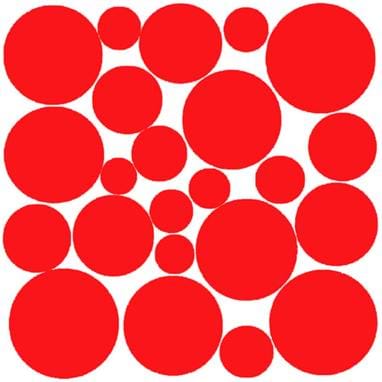
red dots

Correcting your posture is a long road – bad postural habits feel so natural! While you are at The Fix Program, your physio leads exercises and continuously prompts you to adjust your positioning, but once you walk out the door it’s probably hard to maintain. The physio can’t hold you in the correct position all day or sit on your shoulder 24/7 reminding you to exercise and adjust – though I am asked frequently to provide this ‘service’! The treatments we provide are much less effective if they are undone in consistent, small ways away from the clinic or studio.

So what is the best way to work towards a good posture when the physio isn’t around? Become part of the Fix Red Dot Program! If you have done our beginners classes you may remember being given some Red Dot stickers to pop around your home and office, and here’s what it’s all about.

In your assessment and your ongoing classes, your physio will have picked up a few postural errors that you are making repeatedly. Common ones include:

  • Springing your ribs forward
  • Flattening your lower back arch, tipping water out the back of your pelvic bowl
  • Gripping your bottom muscles
  • Bearing more weight through one foot than the other
  • Bearing too much weight in the front or the back of your feet
  • Hitching your shoulders up and forwards
  • Tensing your neck and jaw
  • Turning your toes out, knees in
  • Poking your chin forward, dropping the big mango between your chin and chest
  • Leaving your pelvic floor and deep tummy muscles inactivated before and during big movements
  • Bending with your back rather than your legs.

Getting on top of your postural errors – brain training

Hopefully only some of these things apply to you! Whether it’s one or several postural bad habits, the first step is to be aware of them, and the second is to have the right manoeuvres to correct them. Jot these down somewhere - ask your physio next time you see them if you’re unsure.

Now think of the places or activities where these habits kick in – perhaps it’s while you’re working at your desk, in your car during peak hour, doing the dishes, changing nappies, or even just walking around the house. Jot those down too.

Time to break out the Red Dot stickers! Put these all around your home and office, making sure each location and activity on your list is covered. Put one on your computer monitor, one by the dishwasher, one on the rearview mirror, sink, laundry machine, feeding chair, changing table etc. You get the idea!

These dots are now triggers for your mind – whenever you see one it will cue up your correct posture, a reminder to develop the little physio in your own mind. Red Dots can mean:

  • “Think tall!
  • Neutralize your pelvis!
  • Let your butt go!
  • Tuck your chin in and float your ribs!
  • Relax your neck and shoulders!”

They can be whatever you need them to be. The continuous, daily corrections you make outside of your time in our clinic will ensure the treatments you receive stick, leading the way to a pain-free and relaxed posture. It’s just like having one of us cueing you over and over throughout your day, prompting you to refresh your posture and protect your body throughout those most aggravating activities for you.

After a week or so, take your dots down and move them all just a little. If you leave them in the same place for too long, they can blend into the background and won’t be as good at triggering your good postural habits. Don’t move them too far, just enough to jolt you each time you see one.

Best of luck, and let us know what you think. And remember if you need some Red Dots, don’t hesitate to ask us for them next time you’re at physio or class.


20 Feb 2015 BY Katrina Tarrant POSTED IN Exercise, Pilates, Pregnancy

Pilates and breath

Learn to breathe well and relax

There are many reasons why we should learn how to breathe well. Appropriate breath can help our bodies in many ways and its importance is somewhat overlooked. Breathing can bring about relaxation, reduce stress levels, decrease pain, increase feelings of good health and wellbeing.

So, what makes me stressed?

We’ve all heard the expression ‘fight or flight’. This is how the body has evolved to respond to any threatening situation. In times of stress the body uses a hormone called cortisol. Cortisol turns on processes we need for survival and switches off processes that are not needed for survival. This is great in an emergency, but if you are stressed all of the time, prolonged elevated cortisol levels have been found in blood streams. These chronically high levels are linked to depression, mood swings, memory changes, poor healing, pain, weight gain and immune problems.

On the flip side, when you’re relaxed and feeling good, your body produces ‘happy hormones’ such as opioids and serotonin.

How do I de-stress?

  • For a start, try to stop worrying. Pilates, Yoga, relaxation, meditation and breathing techniques have also been proven to reduce the level of circulating stress hormones and increase your level of happy hormones.
  • Try going for a walk, listening to relaxing music, or just clearing your mind for twenty minutes every day.
  • Try to set aside ‘worry time’. Rather than worrying about things constantly (and keeping your cortisol levels elevated) make a specific time every week when you think about your worries. If a worry enters your head at another time, like when you’re trying to fall asleep, set it aside for your ‘worry time’.
  • Try this relaxation technique when lying down or sitting comfortably. Close your eyes and focus on your deep breathing. Focus on the cool air as you breathe in through your nose and the warm air and you breathe out through your mouth. Focus on one body part at a time starting from your head all the way to your toes imagining all your muscles releasing and feeling heavy.
  • Try to take time to practice mindfulness throughout your day. Even a minute here and there to become mindful of your breath, the comings and goings of your body sensations, tensions and your surroundings can help to de-clutter your brain and provide energy and calmness.

And there’s even more to the importance of breathing well

We also know that learning to make your diaphragm stronger by breathing well has many a physical effect. This is the breath we strive for at your Fix Program classes. These can include:

  • A more efficient delivery of oxygen to your body. Using your diaphragm allows for greater volumes of air into all corners of your lungs.
  • The physical mobilising and stretching effect of breathing into your lower lungs will improve movement of your ribs and the stiff thoracic or middle spine.
  • The prevention of extra work and tension of the chest and neck muscles which are often inappropriately used for daily breath. Most of us know how tired these muscles typically are anyway. Why add to that with your breathing style?
  • A stronger deep postural ‘corset’ for our spine and pelvis. The diaphragm has connections to many organs and muscles in the trunk via fascia and via this connectivity has a crucial role in stability and movement control in the region.

Yes, the diaphragm is a muscle that too can be strengthened! And a stronger diaphragm will lead to a stronger deep abdominal corset, pelvic floor and spinal alignment.

The challenge

Try to become more aware of your breath as you go about your busy lives. This can happen anywhere – at work, rest or play. Slow down the rate of your breath, relax your neck and shoulders and visualise the breath into your lower ribs. Imagine breathing widely and sense the expansion and movement in your trunk.

Slow your breath and the mind will follow. Healthy mind, healthy and strong body.


17 Feb 2015 BY Heba Shaheed POSTED IN Exercise, Pregnancy, Women's Health

Exercise risk and the pelvic floor

Don’t feel the pressure!

Are you feeling that your body isn’t the same as is it used to be. Maybe you’ve just had a baby. Maybe you’re recovering from an injury to your lower back or pelvis – yes men, this includes YOU! Maybe you’re going through menopause. Effects of these events on the body’s muscles are great and sometimes may be overlooked. This is particularly so about the pelvis and the pelvic floor muscles, where pain, injury, or cessation of regular activity and exercise can cause weakness and poor control.

You may wonder:

  • Which exercises can I do?
  • Which exercises should I be avoiding?
  • Which exercises are high risk?
  • Which exercises are low risk?
  • Can my pelvic floor cope with the exercise I used to be able to do?

situp

What is the big fuss about pressures on the pelvic floor muscle system?

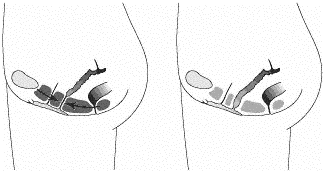
Forces generated by activities of exercise and daily living on the pelvic floor may be too great if you have little strength or control. Repetitive jogging or exercise may be too much for these muscles to take and the risks associated include loss of bladder or bowel control, pelvic organ prolapse( falling down of the organs within your pelvis – bladder, bowel and uterus for the women) and chronic back and pelvic pain.

What is ‘risky exercise?’

First, let’s decide what makes an exercise more risky for the pelvic floor. The table below shows the different pressure transmissions in the pelvis and in the abdomen during different exercises. The lower the pressure values, the less “risky” the exercise is to the pelvic floor. This means that, the further you go down the table, the more likely the exercise is going to cause bladder or bowel issues. For example, you are more likely to leak a bit of urine with jogging or coughing than you are with crunching or walking.

For you guys out there who have bothered to read down this far, intra-vaginal pressure could be swapped for intra-rectal pressure. Remember we all have the same functioning pelvic floor -give or take- whether we are male or female.

Exercise

Intra-vaginal Pressure

Intra-Abdominal Pressure

Lying down at rest

5

-

Lying down on your back weights

10

-

Crunches - breathing

Crunches – holding breath

12

24

68

Standing at rest

24

39

Sitting at rest

25

-

Stair climbing

-

70

Walking

26

76

Stand from chair

-

79

Supine low bicycle

32

-

Seated arm machine

37

-

Seated leg machine

44

-

Seated abdominal machine

54

-

Free weights from floor (10kg)

>45

122

Squatting or lunging

-

-

Jogging

64

100

Jumping jacks

-

127

Laughing

86

-

Forceful cough

98

136

So what are the take home points?

  • Always breathe through the exercise – holding your breath can double the pressure in your pelvis.
  • There’s no real difference between sitting weights training and standing weights training in terms of the effects on the pelvic floor.
  • Crunches and sit-ups are always given a bad rap with regards to pressures on the body and the pelvic floor. They actually produce less pressure than any other seated or standing exercise, and even less pressure than just standing upright! They might not be the best exercise if you have a neck or back injury or an abdominal separation though.
  • You need to invest more in managing hayfever or asthma to prevent bladder or bowel accidents than avoiding exercise.
  • You need to really build the strength, endurance and coordination of your pelvic floor if you’re struggling with control during any exercise, especially aerobic exercises such as jogging or jumping. A women’s or men’s health physiotherapist can guide you to ensure you do these exercises correctly and she can prescribe an individualized pelvic floor program just for you.

So now you know the risks of exercises on the pelvic floor. But this doesn’t apply as a blanket rule for every woman or man. Another important thing to consider before you return to exercise is your individual risk. Whether you are high risk or low risk depends on your body and your individual circumstances and experiences.

Your individual risk comes down to six things:

  1. How strong are your pelvic floor muscles?
  2. What is the size of your levator hiatus (the space between the two sides of the pelvic floor muscles) at rest?
  3. How distensible are your connective tissue in your pelvic floor i.e. how much do they stretch?
  4. Do you have pelvic organ prolapse?
  5. Do you have levator avulsion (tearing of the pelvic floor muscles)?
  6. What is the state of your hormones?

What can I do to be sure my choice of exercise is the right one for me at this time of my life?

For you women, your women’s health physiotherapist at The Fix Program is able to assess these six factors to determine your individual risk; and combining your risk with the risk of exercise, she will be able to tell you which exercises are suitable and which exercises you may need to build up to with time, as well as which exercises you may need to avoid.

In addition to this, your women’s health physiotherapist can help you strengthen your pelvic floor muscles including the muscles that may have some tearing, manage your prolapse (perhaps with the fitting of a pessary to support your connective tissue), as well as guide you with nutrition and lifestyle advice to promote hormonal health.

For you men out there, there are men’s health physiotherapists who can also assess your risk factors, pelvic floor weaknesses and help you to train these all important multi functional muscles. Ask us for details if you need them!


15 Dec 2014 BY Katrina Tarrant POSTED IN Exercise, Pilates

‘Core stability’ or ‘postural control’

To plank or not to plank? 

It is a common claim that a strong core will enhance movement ability, such as for walking and running. ‘The Plank’ and similar ‘core’ exercises are therefore often prescribed to achieve this. But how appropriate are planks for our everyday movement requirements? Postural control sitting at your desk, turning, reaching, walking, swimming or running? Do we really sit, walk or run looking like a plank?

In effect, if we strengthen muscles in a particular way, they will be terrific and strong in that, but not necessarily with a cross over effect to other movements or requirements. This is called ‘training specificity.’ Muscles and movements needs to be precisely and specifically trained to optimise gains in strength and movement quality.

So what about muscles involved in ‘core stability’?

When we speak about ‘core stability’, stability suggests rigidity and no movement. However, don’t we really want to be able to bend and move through the spine and body? Think about your average day and the range of movements involved - turning, twisting, and bending, from popping on your socks to start the day, to twisting your head and trunk to reverse out of the driveway in your car.

In exercises like ‘the plank’, there is the need to brace and co-contract multiple muscle groups at one time. This is a model relying on stiffness. However, stiffness in our bodies does not necessarily result in better function. Walking and running activities are perfect examples of this where there needs to be free trunk rotation as the arms swing, and free rib expansion and movement for greater breath capacity.

Instead of ‘core stability’, a better term to use would be ‘postural control.’ This suggests that muscles need to be strong and efficient within movement, controlling you throughout. When we move, there is a whole team of muscles working. There are the little deep ones holding on at your joints, while the team of bigger ones move you. Even these bigger ones work to control the movement speed and precision. So to get these teams working like a well oiled machine, exercises should be practiced to mimic both the movement and postures involved.

At The Fix Program pilates classes, we work really hard at making sure we follow this theory of strengthening, exercise and movement. How do we do this?

  • Have you noticed we spend a lot more time now strengthening your ‘postural control’ muscles in many varied postures – standing, sitting, stepping, twisting and lying?
  • We teach you how to be more precise and aware about control (not rigidity) about the pelvis, the ribs, the neck and shoulder blades.
  • We use visual cues such as ‘float through your postures’, ‘feel more fluid in your movement,’ becoming aware of breathing symmetrically through the rib bases. All of this is in contrast to bracing or rigidity in postures.
  • We have introduced more Feldenkrais and Yoga type sequenced exercises where movement is free and awareness is paid to differences/asymmetries across our bodies.

There is nothing wrong with continuing to plank, so if you enjoy these, go for it. They do always feel like a brilliant challenge for the body. But do be aware of the need to exercise with movement also.

At the end of the day it’s more about beautiful movement, free and flowing.


9 Dec 2014 BY Katrina Tarrant POSTED IN Pilates, Sydney CBD

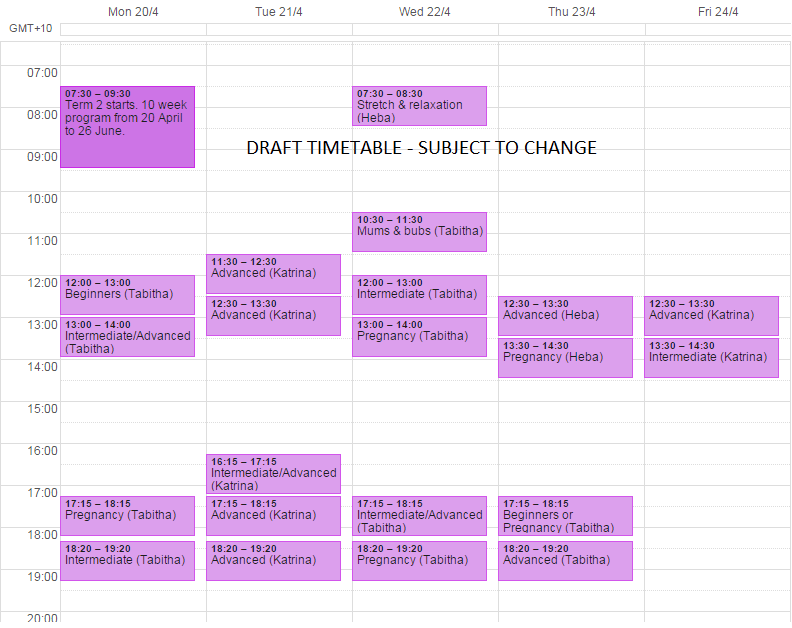
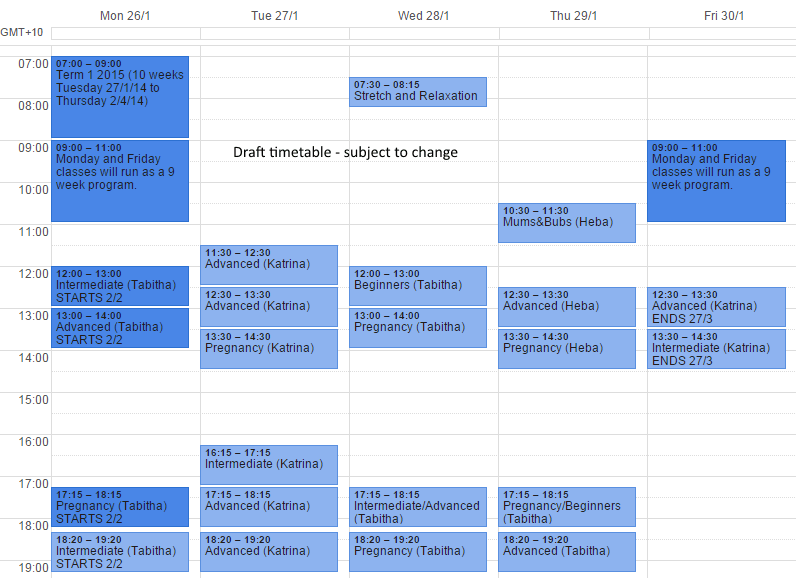
Draft Pilates Timetable Term 1 2015


26 Nov 2014 BY Katrina Tarrant POSTED IN Exercise, Pilates

The real bird dogs

A silly name for a difficult Pilates move

Bird dog

Taking me several years to get the name right for this exercise, I really have struggled with the ‘Bird Dog’. You know the exercise. Lifting and stretching out your arm and opposing leg from your hands and knees. We assume the name comes from the hunting dog poses. The dogs that hunt birds?

Perhaps it is these little critters we are trying to be?

Then again …

All in the name for a good laugh. Check these ones out too.

http://imgur.com/gallery/tyQrv


12 Nov 2014 BY Katrina Tarrant POSTED IN Pilates, Sydney CBD

Draft Pilates Timetable Summer School 2015


22 Oct 2014 BY Katrina Tarrant POSTED IN Back Pain, Physiotherapy

A physiotherapist’s guide to back packs

Tips on choosing the right back back

Considering that 60-80% of us will experience back pain in our lifetime, choosing the correct back pack for us or our children should be a priority. The high number of children and adolescents already complaining of back pain is astounding. Studies recently in South Australia of 2500 children found half of them repeatedly complained of pain episodes. Victorian studies concluded that 1 in 3 school children suffered back or upper neck pain, caused by heavy schoolbags.

Providing a good back pack to everyone is crucial, and educating on its proper use vital.

Here’s the physio’s guide to choosing a good back pack.

  • Make sure it is appropriately sized for you. It should neither extend past your shoulders when sitting down with it, nor be wider than your chest.
  • Be comparatively lightweight. Fully packed it shouldn’t weigh more than 10% of the your body weight.
  • Be sturdy and reasonably water-resistant (or have a rain cover). The material should be firm to prevent sagging. The base should be abrasive-resistant and/or reinforced.
  • Have a moulded frame and/or an adjustable hip or waist strap, so most of the weight rests on your hips and pelvis, not on your shoulders and spine. The waist/hip belt is particularly important to secure the load when walking, running or cycling.
  • Have adjustable, broad, padded shoulder straps that help distribute the weight evenly across your shoulders and and don’t dig into you.
  • Have a padded or quilted back for comfortable wear.
  • Have compression straps at the sides to draw the load together and bring it close to your back. They’ll also help stabilise the contents of a partially filled pack.
  • Have a sternum (chest) strap to help stabilise the load and prevent the straps slipping off the shoulders. It should sit about 10 cm down from the Adam’s apple.
  • Have several pockets to help with even weight distribution and organisation inside. A drink bottle holder on the side keeps potential spillages outside the pack.

So, now that you have the right back pack, here’s how to use it properly.

  • Backpacks are designed to carry a load safely — symmetrical, stable and close to the spine — but not if they’re worn casually slung over just one shoulder.
  • Put it on safely. Try to lift it up by the loop with both hands and bent knees, facing the straps and pushing up with the legs. Place one strap over the shoulder, then the other, or put it on the edge of a desk and loop both arms through together.
  • A backpack should be worn so the waist strap (or hip belt) sits firmly where intended.
  • Shoulder straps should be adjusted so that you don’t have to lean forward and the base of the pack rests on their hips, not on the bum.
  • Pack your back pack properly. Items shouldn’t be able to move around; the heaviest ones should be packed closest to your back to reduce stress on the spine, lighter items away from the spine.
  • Pack only what you need to keep the weight down.

The Australian Physiotherapy Association (APA) endorse a back pack for children. Called the PhysioPak, it meets the standards of the APA. With multi-adjustment straps at the shoulders, waist and chest, and a moulded back that rests well and at the correct angle to the spine. See http://www.spartanss.com.au for further details.

For more information please contact us


22 Oct 2014 BY Tabitha POSTED IN Pilates, Pregnancy, Women's Health

Physiotherapy, Pilates and pregnancy hormones

Is relaxin as good as it sounds? 

A woman’s body completely transforms during pregnancy, growing and stretching all over in a very short time. Supporting the growing weight requires all sorts of internal reorganising, particularly in the lower back and pelvis. The pelvis eventually becomes elastic enough to allow a baby to pass right through the middle of it – all of this, and more, thanks to the hormone relaxin

Where does it come from?

Relaxin is produced by the sex organs in both men and women, just like many other hormones. Each gender uses it to do different things, but it gets its name from its role in reshaping a pregnant woman’s body. Relaxin production surges within a few days of conception, and the uterus, placenta and breasts start making it too. Its levels are the highest in both the first trimester and at delivery – we’ll soon see why! 

What does it do?

The increased relaxin directs the body to reconfigure its blood flow – the mother’s organs will be working for two, and there is a lot of plumbing involved! By encouraging a widening or a relaxing of specific blood vessels, the body can pump more blood to where it needs to go (your baby via the placenta, the uterus). From there, the relaxin begins to suffuse into the ligaments of the lower back and pelvis, making them far stretchier than before:

The pelvis widens, ready to support the large and sudden increase in abdominal mass. The relaxin continues doing this work, surging once again at delivery – this is, of course, when the ligaments need to be at their absolute stretchiest, giving the baby just enough wiggle and room to escape.

pelvis anatomy

The most affected ligaments are highlighted in red, with the arrows indicating the direction of movement.

So, what’s the downside?

Ligaments are usually tight and strong in non-pregnant people, serving to distribute force and weight evenly up and down the body. When they become relaxed and flexible, your muscles have to tighten, working harder to compensate. For pregnant women, this can mean a lot of strain in the pelvis, buttocks and lower back that only gets worse as the baby gets bigger and the ligaments even softer. 

What kind of effects does this have?

    pubic symphisis pain (PSP)

If the pain is concentrated at the front, it could be what is called pubic symphisis pain (PSP). The ligament responsible is located where your two pubic bones join together – right in the middle, above your genitalia. When it widens, or when one side rises or falls relative to the other, it can become extremely painful and tender to the touch. It is most commonly felt when

  • rolling in bed,
  • getting in and out of the car,
  • climbing stairs
  • or when just walking.

If you experience such pain, usually offering compression or stability about the joint may assist reducing pain and improving every day function. Wearing a pelvic stability belt can help reduce stretching in the affected area, while pelvic compression shorts will help the body hold the two halves of your pelvis together. Developing core stability before and during pregnancy will better prepare your supporting musculature – we know that deep abdominal and pelvic floor muscles can offer support and structure about the joint. This preventative strengthening can mean less chance of pain and a reduction of any pain already in this area of the pelvis. This is a big aim of our pregnancy specific classes offered at The Fix Program.

If the pain is on either side of the tailbone, right where your dimples are, it is called sacroiliac joint pain (SIJ). The pelvic bone or ilium (as it usually effects only one side) can move out of good alignment with the tailbone, leaving you with pain in the lower back or down through your buttocks or upper thigh. These joints are usually responsible for smoothly transferring weight from one leg to the other, so the pain is most commonly experienced during activities that involve standing on one leg while lifting the other, including

  • walking,
  • standing up from sitting,
  • rolling and standing up from bed,
  • or even getting dressed.

Fortunately, the treatment for any of these symptoms is the same as for pubic symphisis pain. This will include wearing pelvic compression garments, pregnancy-specific core stability exercises and stretches, and hands-on physiotherapy treatment.

Do the effects last?

The good news is that your ligaments will likely return to normal once the relaxin returns to its normal levels and you are no longer weight-bearing for two. Of those that experience either type of pain during their pregnancy, four out of five women have their discomfort spontaneously resolve within three months after the birth. For the unlucky Ms. Five, there is a lot understood about the pain and many ways that the Fix physiotherapists can help you out!

Relaxin is an amazing part of the incredible transformation of pregnancy, playing an essential role in preparing a woman’s body for the task of sustaining and delivering a new life. These changes might be challenging or painful for your body, which is why the Fix team will be ready to help you before, during and after the arrival of your new baby.


Fix News