
The Fix Program Blog

15 Dec 2012 BY Katrina Tarrant POSTED IN Exercise, Pilates

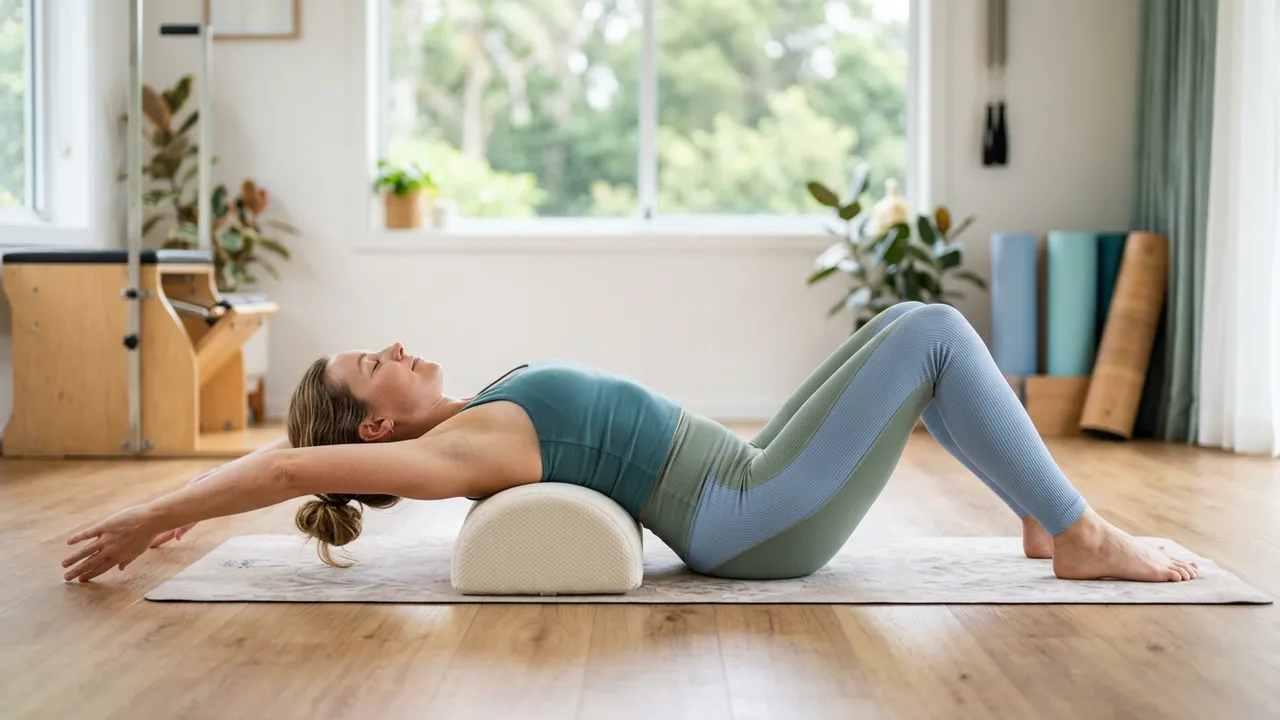
Exercise of the Month: Snow Angels on the Bolster

Treat your thoracic spine with Love

As you may be aware, our thoracic spine or mid back does become increasingly stiff as we spend more and more time in sedentary postures. Although, along with the ribs it is there to protect your lungs, heart and other internal organs, your thoracic cage should be mobile and help therefore to unload the neck above and lower back below. Enjoy these stretches for the mid back and chest using your D-shaped bolsters.


The Starting Position:

The focus:

  • Lie on your back lengthways along the bolster, making sure it is centred down your spine. Have your knees bent in to the basic relaxed position, with feet hip width apart.

  • Place your head on your folded towel which is also positioned at the top end of your bolster. This will support your neutral neck posture. Gently lengthen and then relax through the back of your neck.

  • Find your neutral pelvis posture by tilting your ‘pelvic bowl’ forwards and back to reach your neutral zone. Become aware of the heaviness of your tail bone on the bolster.

  • Rest your arms down by your sides with palms turning up.

  • Move the arms in a floating and relaxed manner.

  • Focus on keeping your neck soft and long, shoulders away from your ears.

  • Try to keep your tailbone heavy on the bolster.

  • Try to control any springing of your ribs at the front of your trunk as your arms lift.

  • Really enjoy this exercise as both a stretch and a form of relaxation. Get into the rhythm. Don’t worry about how many you do.

The Movement:


  • Breathe in deep and wide, lifting your arms straight up above your head. Lead this movement with your thumbs.
  • As you exhale, sweep your arms in a wide circle, gently reaching for your feet.
  • Repeat these movements as you continue your deep relaxed breathing.


Tip:

This position on the bolster is fantastic for relaxation. Close your eyes, focus on your deep breathing and letting go across your chest for that ultimate upper back treatment. It’s a perfect way to wind down after being at work all day.


5 Dec 2012 BY Katrina Tarrant POSTED IN Sydney CBD

Draft - Term 2 Sydney CBD Timetable


5 Dec 2012 BY Katrina Tarrant POSTED IN Exercise

Dynamic Stretching – The Newest Way to Warm Up

Melanie explores: Dynamic Stretching

I’ve been researching stretching lately as I am embarking on creating a DVD. When Luke Fuller, a former Fix instructor and now Physiotherapist and Osteopath for the ATP world tour sent through his first published article I was very excited to read that it was on stretching.

His article is based on the sport of tennis, but it is following a trend in the current literature that ‘dynamic stretching’ can be used with all forms of sport and exercise regardless of your level or ability. The article explores the benefits of this form of stretching over ‘static stretching’ as warm up prior to full intensity exercise.

Dynamic stretching includes a more active warm up where the joints are taken through their full range of movement slowly, then gradually increasing speed and moving into sports specific movements. For example, moving your shoulder in a full arc (as opposed to holding it in one position), followed by moving the shoulder through the actual motion of a tennis serve. This form of active warm up has been shown in the research to be more effective by increasing the temperature of the muscle and better preparing the body by activating the nerves within the muscles. This was especially noticeable when concerning force and power exercises.

The research still shows that static stretching can be useful after exercise to work on specific areas that may be tight. This is where being aware of your body and the demands of your exercise can help you to discover a warm up and cool down specific for you.

Follow this link to the full article where there are specific exercises for tennis that you may be able to apply to your own sport or exercise. Keep this in mind next time you go for a run, walk, or play basketball, netball or volleyball.

http://stms-web.org/pdf/JMST-October2012.pdf

Download the PDF file and find Luke’s article (pg 109) entitled

Pre-Competitive Warm-up: the Current Literature Suggests that Dynamic Stretching is Preferential to Static Exercises.


5 Dec 2012 BY Katrina Tarrant POSTED IN Exercise

Pelvic Floor problems in Men

For the boys…Do I even have a pelvic floor?

I was recently referred to this magazine article in an American digital mag. Pelvic floor dysfunction is often thought of as a ‘woman’s thing’, but as this article explains, men can suffer from the range pelvic floor troubles too, from incontinence to pain in the testes and deep pelvis to poor sexual function. Again and as with the women, these are not normal and warrant further investigation. There are even a handful of male physiotherapists specialising in men’s pelvic floor dysfunction in Sydney who are out there to help. Check out Stuart Baptist in the CBD.

http://www.voxxi.com/pelvic-floor-dysfunction/


5 Dec 2012 BY Katrina Tarrant POSTED IN Pregnancy, Women's Health

Pelvic Floor Problems in Women

Further Reading for ‘discovering’ Your Pelvic Floor

On the topic of all things women (sorry boys), I’ve found you a great website and book worth checking out from Queensland women’s health physiotherapist, Mary O’Dwyer. Her experience managing all things women and pelvic floor make for a fun, yet sensitive approach to managing and treating pelvic floor problems such as stress or urge incontinence and pelvic girdle pain.

I found the book easy to read. Following her ‘exercises’ and ‘explorations’ were, I’d admit, a little confronting, yet very useful and insightful.

Subscribe to her newsletters or facebook for weekly reads. Share it with your girlfriends.

http://www.holditsister.com

‘Hold it Mama: The Pelvic Floor and Core Handbook for Pregnancy Birth and Beyond’ by Mary O’Dwyer (2011)


14 Nov 2012 BY Katrina Tarrant POSTED IN Exercise

Can exercise decrease your chances of dementia?

ABC’s Tonic Program – Exercise and Neurological Disease

There is recent evidence out there that only 150 minutes of exercise per week of cardio vascular exercise can halt the decline in cognitive ability as is seen in Alzheimer’s disease, Parkinson’s disease and dementia. This exercise only needs to be aimed at an intensity level of a brisk walk or higher. There are several factors that could explain this finding, from increased oxygenated blood levels to the brain as a effect of exercise or changes in enzyme levels in the brain that are known to cause dementia. Watch the first story in this episode of Tonic to learn more.

http://www.abc.net.au/news/2012-11-14/tonic-series-5-episode-1/4367170


26 Oct 2012 BY Katrina Tarrant POSTED IN Exercise, Pilates

Exercise of the Month: The slump slider

Get your sciatic nerve moving

As you may be aware, nerves and associated neural tissues need to be mobile, just as muscles and joints do. We know that nerves that slide and glide well in the body are also well nourished nerves with great blood supply. This means happier, less sensitive nerves. And this often means reduced hyper-activity of the electrical impulses that fire along the nerves to your brain, contributing to the pain response decided by your brain centres.

So, let’s get sliding!

The Starting Position:

The focus:

  • Sit on your mat or floor with your legs out straight in front of you. If you have tight hamstrings, let your knees bend a little so that you are comfortable.

  • Place your arms around your thighs as if to give your legs a little hug. This will bend and roll your spine forward into flexion.

  • You may feel a stretch here in either the legs or spine-don’t worry, this is very normal.

  • Keep your breathing deep, relaxed and consistent**.** Picture your nerves sliding up and the down the back of your leg and back with these movements in each direction.

  • Really focus on the movement occurring only at your ankles and neck as you keep the rest of your body nice and still and in that flexed forward posture. Don’t forget to relax your shoulders too.

The Movement:


  • To slide the sciatic nerve up and down in the leg, start by putting your chin slowly down onto your chest. Do you feel a stretch here, perhaps in your neck, mid back or legs?
  • This is the little pull on your nerve structures.
  • Now keeping your legs as straight as you can and spine rolled forward in that hug position, slowly lift your chin off your chest and pull your feet back as far as you can from the ankles.
  • This should bring on a stretch down the backs of your legs. Do you feel this?
  • This is the sciatic nerve stretching. Repeat this sequence up to 10 times slowly. Imagine you are ‘kicking your head off.’


Tip:

Try adding this to your leg stretches – those buttocks, hips and hamstrings. It’s a perfect way to end your stretch session and keep your nerves smiling.


22 Oct 2012 BY Katrina Tarrant POSTED IN Exercise

Pace it, don’t Race it – Goal Setting and Safe Pacing Strategies

Set your goals and don’t be afraid to go after them!

I am often asked “how do I get fitter?” or “how can I ever get to carrying the shopping without my neck pain?” or “how can I learn to sit longer at my computer comfortably?” The consistent answer I give to all of these questions is “pacing”.

Pacing is defined in the Oxford Dictionary as ‘to do something at a slow and steady rate in order to avoid overexertion.’

You can use this technique to achieve your goals. Most people –including yours truly- find that they are in limbo with often no clear goals. Or even if they do have clear goals, no way in which to tackle them head on. Fitness goals, strength goals, activity goals, running or swimming time goals. So before we start using this pacing technique, we have to really think about what our goals are. I’m included here.

Ok, let’s take the goal of improving your fitness without worsening your pain. Pacing, as defined above, means the art of doing a bit more -but not a lot more- every day so you gradually build up strength and stamina and get fit. People say that the mantra “pace it, don’t race it” is a good way of remembering the tip.

Before we discuss the best pacing strategy let’s look at 2 common relationships people have with exercise and activity when they are in pain. The first is ‘the slow decline’. This is the person who quite naturally stops an activity or exercise when the pain starts. They wait till later and have another go. However with time the pain starts with less and less activity.

The second is ‘the boom or bust’ pattern. This is the person who tries to get a whole task done, push through, ignore the pain and keep going despite the pain. After this, they can’t do anything. They might need rest for days before having another go. Improvement in fitness, strength or tolerance is minimal.

So here’s a guide on how to get your pacing diaries established and your journey to greater activity and fitness started.

Step One: Write down your personal exercise and activity goals.

Everyone’s goals will be very different. But think about what you would like to be able to do more of. Perhaps it is to sit for 1 hour so coffee with the girls doesn’t hurt your neck? Or perhaps it is to walk up the long flight of stairs without stopping at Martin Place train station? Or to walk 5 kilometres, 3 times per week? Or to run the City to Surf without stopping? Or perhaps to beat your 10 kilometre run time by 2 minutes?

Try to have 1 or 2 goals going at a time and remember that the goal posts need to keep moving. You will eventually achieve these goals because after reading this, you will know how to get started and to safely attain them.

Step Two: Find your safe baseline on which to build.

Your correct baseline is all about finding the amount of your goal-related activity that you can do safely and without falling in a heap. Like your goals, baselines will be different for everyone. It’s personal. But as an example, you might say that you can walk for 30 minutes and definitely won’t have a flare up of your sore hip or back, and won’t take a week to recover. You remember that last week, you were absolutely shot after your hour long walk on the weekend. In this example, your safe walking baseline is 30 minutes.

Using the walking the stairs at Martin Place example, you know from your stairs at home that you are puffed and need to pause after 20 steps. You feel dizzy and very puffed out after the whole flight of 25. 15 is easily and consistently manageable. I would suggest a baseline here of 17 or 18 steps.

Step Three: The only way is up!

Now you need to plan your progression (in advance). Using time as a guide, choose small increments to increase your baseline. For example, you could choose to walk for an extra 5 minutes each week from your 30 minute baseline, or try to walk up an extra 2 steps without stopping each week.

When you complete the set amount of activity and are feeling good, don’t be tempted to push on beyond your planned progressions. Stick to the plan and be patient. Knowing that you will only be doing a small, ‘safe’ extra amount each time will decrease the threat level for your brain. This makes it less likely that your brain will become over protective and try and use pain to stop you from moving or working towards those goals.

As a general guideline, do not increase your progressions by more than 20% of the last level achieved. This way you will remain ‘safe’ and yet slowly trek upwards to your goal.

Step Four: Always keep going and reward yourself.

Remember, we all have our ‘bad days’ where things may hurt a little, or you feel unusually tired. If you do have a little flare up at any stage during your planned progressions, don’t freak out. It’s good to know that your brain is looking out for you! Your brain is doing its best to protect you and this pain does not mean that you’ve caused any damage. It’s ok to rest for a day. Now go back one step to what you know you did before with no troubles and resume your pacing program. Try not to stop altogether. You’ve probably gone so far and to start again at the beginning would be more than a little frustrating and upsetting.

And don’t forget to acknowledge your achievements with a reward. An imaginary pat on the back, a few quiet encouraging words to yourself, an ice cream, that favourite magazine or new dress! Take time to reflect on your goal attainment and reset those new ones.


22 Oct 2012 BY Katrina Tarrant POSTED IN Back Pain

Pain: Knowledge is a Powerful Tool

Physiotherapist, Lorimer Moseley talks pain.

Research over the past decade has shown that in the management of chronic pain, education and knowledge about pain provides best long term outcomes, particularly if coupled with an exercise based program for these individuals.

Lorimer Moseley, a most wonderful physiotherapist, trained at Sydney Uni and left the world of manual therapy very early on in his career to find answers to his highly inquisitive side. He has since pursued a career in research, writing and speaking about the brain and specifically, its very important role in pain. He holds a PhD and is now the Professor or Clinical Neurosciences at the University of South Australia in Adelaide.

Spend the 24 minutes watching this youtube clip of him recently speaking in Sydney. You will not be disappointed and it may even change the way you look at pain forever. Knowledge is a powerful thing.

http://www.youtube.com/watch?v=RYoGXv22G3k

If you’d like to explore this topic more, he is the co-author of the book ‘Explain Pain’(2003), written with David Butler (another brilliant physiotherapist), and has written his own book named ‘Painful Yarns’(2007). You can also visit www.noigroup.com for all things pain.


19 Sept 2012 BY Katrina Tarrant POSTED IN Exercise

Exercise of the week: Single Leg Squats

This will really get those buttocks going!

This is a fantastic exercise as it is performed in standing which is when we need both the muscles around the knee and buttock working to give us stability. Even more important if you spend a lot of time power walking or running.

The starting position:

Stand next to the wall with your right shoulder at the wall. Place the stability Chi ball between your right knee and the wall. Stand on your left leg so that your foot is straight, your left knee is in line with your 2nd/3rd toe and your hip. Find your neutral pelvis by tilting the pelvis backwards and forwards and resting in the middle position. Think tall with the spine and neck. Use your right hand on the wall for support to help keep your trunk straight.

The movement:

Standing on the left leg, squash the Chi ball with your right knee. The control to counteract the pressure pushing you away from the wall is provided by your left buttock muscles. This primarily is your gluteus medius muscle, very deep and in the upper portion of your buttock. Hold your pelvis still as you perform a ¼ squat on your left leg and return to standing. During the squat maintain the knee in line with the 2nd/3rd toe. Repeat 8 times then swap sides.

Your focus:

Try to maintain your pelvis in a neutral position and keep it level across the hips. Also keep tall and try to avoid allowing your trunk to fall to the side. Keep your waists long and even! If you are maintaining this, your trunk postural muscles and core muscles will be really working in addition to challenging those thighs and buttocks.

Remember that strong legs and buttocks support your trunk!

Katrina


Fix News