The Fix Program Blog

4 Jul 2019 BY Katrina Tarrant POSTED IN Exercise, Physiotherapy

Happy feet! Some steps to take for supple and strong feet

Some steps to take for supple and strong feet

**by Julia Newton, physiotherapist
**

We use our feet everyday. After-all, it is our mode of transport! So why shouldn’t we make foot health one of our main priorities? Keeping feet flexible and strong is not just important for preventing pain and injuries, but it can have a profound effect on the rest of your body. If you are loading well in your feet, this can really help set you up for optimum movement while you get about.

Here are 4 great tips  on how to become more aware and caring of your feet.

Self massage and mobilise your feet.  This is not just a great feeling after a long day on your feet, but also an important step in keeping range of motion in your feet! Just pick up one foot, grab your toes, extend them up towards your ankle and massage out the arch of your foot.

Walk in bare feet when possible. This is where you are getting the most feedback from your feet to your brain and vice versa. Pay attention to how you’re loading your feet while you’re walking. The added bonus here is that by walking slowly and mindfully, you’re also calming your nervous system and feeling that grounding effect of your feet on the floor! However if you’re a runner or regularly exercise in shoes, it might be worth also feeling how your feet are in shoes as well

Exercises for the intrinsic muscles in your foot. Intrinsic muscles in the foot are small muscles located in the sole of your foot that are responsible for providing arch support and fine motor movements. Toe curls is an example of a traditional exercise that challenges the intrinsic muscles in your feet. Simply place a towel under your foot and scrunch your toes so that the towel is pulled towards you.

Practice good balance. Try standing on one leg with evenness throughout your foot. Notice if you tend to weight bear on one side of the foot more than the other or if you’re scrunching your foot in order to keep your balance. You can even challenge this further by balancing on a cushion or bosu ball, or make it easier by holding onto a wall with one or two fingers. There should be some amount of effort in your foot, but not to the point that you’re feeling tighter as a result

Have a go at doing the above action points and let us know how you go! If you have noticed anything about your feet or if you simply would just like some more information, we would love to hear from you!


Sex during pregnancy?

Yes please!

by Aline Filipe Nunes, women’s health physiotherapist

Pregnancy is an event when many changes occur in a small period of time. The changes can affect your body, your mood, your fatigue levels as well as several psychological and social factors.  It is with no surprise that pregnancy can have an impact on your sex life and sexual routine.

Pregnancy is in its core a period of preparation: your body and your mind focus in building a baby but also prepare for the arrival of a new family member. The roles of parenthood start changing here. It is quite common that the future parents start feeling anxious or depressed during pregnancy in anticipation of the arrival of their baby. The anxiety in itself and the anticipation of the impact of the baby in the couple’s life, as well as the anticipation of the changes in the roles, can be enough to change how you feel as a “sexual being”.

I just don’t feel like sex now that I am pregnant

During pregnancy, many studies show that there is a decrease in sexual interest, decrease in sexual thoughts, decrease in the willingness to initiate sexual advancements and a decrease of the genital and non genital sensitivity. Physically, the hormonal changes can often lead to vaginal dryness too. 

Your pelvic floor muscles can also play an important part in the change. While dryness can become a problem in itself, during pregnancy your pelvic floor and the pelvic structures suffer some changes. Although some pelvic floors can become “tight” ( and therefore painful with sex) in response to the increased weight and body changes, others can become easily fatigued and problems such as prolapse and urinary incontinence can surge. Urinary incontinence and prolapse are two major factors that have a tremendous impact on body image.

Body image can also play a large part in the decrease in sexual interest. Many studies show a positive association between body image and sexual interest, meaning that the better you feel about your body, the more interested you become in engaging in sex.

On top of all of this, some studies point that about 80% of women during pregnancy feel some type of lower back discomfort. Pain in itself can be an important factor in the unwillingness to participate in sexual activity. It is important to treat the pain as soon as possible and to work with the mother-to-be and her partner, in order to bring function and movement back. This ideally will  promote mobility that will help towards sexuality.

Sex in pregnancy has wonderful benefits

Sex during pregnancy brings several benefits for the couple. On a physical level, sex and intimacy are fantastic methods for relaxation. Intimacy is also crucial as emotional support and as a way for the couple to feel sexually desired and hence, still see themselves as a “sexual beings”. Sexual activities can also be a great way to improve bonding, improve sleep, burn calories, improve mood and even improve your immunity.    

How can I become more sexual in pregnancy?

It is important to see this special period of time as a crucial event in the life of a couple.  There are many big changes that have a tremendous impact in their lives, including pregnancy and the arrival of a new baby. Women’s health physios are there to help any couple find balance again via offering several options.

  • Exercise is known to improve body image, whilst also bringing many health benefits to you and your baby. Physio-taught pregnancy classes are a wonderful place to exercise safely, meet other pregnant mums and to hopefully make you feel great about yourself!
  • Education and treatment sessions with a pelvic floor physiotherapist can help with the management of any pain with sex.
  • Pelvic floor physiotherapy can help any woman for the treatment of pelvic floor dysfunction during pregnancy such as incontinence, pain or prolapse.
  • Education regarding sexuality with advice regarding positions, intimacy and lubrication.

31 May 2019 BY Katrina Tarrant POSTED IN Pregnancy, Women's Health

Pelvic pain in pregnancy

Your pelvis is not falling apart…debunking the myths around pregnancy pelvic pain

by Carrie Seow, women’s health physio


Pregnancy-related pelvic girdle pain (PRPGP) is a term that some women are all too familiar with. It can present in many different ways and impact your pregnant life when you sleep, change positions in bed, walk, climb stairs, get in or out of the car, get dressed or put on your shoes and socks. All those everyday tasks you previously never gave a second thought to may have become painful and difficult to do. It can be felt at the front of your pubic region, or across your tailbone and buttocks. It is often blamed on the lower back, but often is not. 

MYTH: “My unstable pelvis is causing my pelvic girdle pain.”

 Recent research from Prof. Sinead Dufour of McMaster University in Canada has noted that this concept of “pelvic instability” is unsubstantiated. Your pelvis is not falling apart! Rather, advanced pain science indicates that the pelvis is more sensitive during pregnancy. This sensitivity is increased by a range of lifestyle factors including the changing posture and load through the pelvis when pregnant, the differing ways in which you move with a belly bump, stress, sleep, and even gut health.

MYTH: :“I should just rest and avoid doing too much for the remainder of the pregnancy.”

Initial rest may be helpful to minimize a flare up of pain, however, we don’t want you to stay in this state! Exercise is the best medicine for pain. You may have heard the “motion is lotion” phrase. More importantly, you need to be strong in the hips, legs and upper body so that your body can carry you through the rest of the pregnancy. Yes, there may be some types of exercise which are not suitable for you during your pregnancy due to the nature of PRPGP but as clinicians we can help design appropriate and safe exercise programs to help you get stronger, which in turn help reduce your symptoms.

“But what if I can’t even get back to exercise because I’m in too much pain!”

 You may need some physio treatment by way of manual (yes, massage and ‘muscle love’!) and exercise therapy to help reduce the sensitivity of your back, hips and legs before gradually increasing your exercise load. For those with more severe symptoms, there are support garments available (e.g. pelvic belts, belly belts, SRC pregnancy shorts) that are available to help support your body in pregnancy to allow you to exercise rather than stopping all exercise. Your physio will retrain the better way of movement control and muscle activation around your pelvis to support and reduce the sensitivity, and all while keeping within those pain levels .  

**“How can I do all those everyday tasks such as sleeping, walking, sitting, putting on clothes and shoes without as much pain?”
**

It’s realistic to assume that you may need to change the way you do certain things when you’re pregnant. We can give you some ergonomic strategies to avoid irritating the sensitive structures in your body during activities of daily living. For starters, rather than balancing on 1 leg, try putting your pants, shoes and socks on while sitting down on a chair.

Catching and managing PRPGP early in pregnancy will help you the most!

Remember, it’s best to start dealing with PRPGP in the early stages rather than waiting until it gets really bad! Book an appointment for a thorough assessment and chat with your physio about the best management path for your pain. This could be manual therapy, home based exercise, or our pregnancy specific Pilates and group classes. Contact us for a chat.


Runner's guide to video analysis

The merits of a great video


We all picture ourselves to look like as graceful and effortless as the most famous of marathoners. However, how often do our bubbles burst when we see a photo or a video at the fun-run finish line?

Running ( and walking for the non-runners) biomechanics play an important role in the development of injuries in active individuals. When pain and the physical examination findings are in agreement with abnormalities observed in a biomechanics running analysis, it serves as a great tool for intervention. What exercises, what running cues, what change in shoes may allow for this person to walk and run injury free? 

Here are a few common issues we see in runners that really set up a risk of the body breaking down, being less efficient and potentially becoming injured. Perhaps you see yourself doing one of more of these when you run? Or perhaps you don’t!

Why not have a friend film you and have it looked at by our physio team? A short 30 second video from the side and from the rear would be all you need, so grab your phone and shoot away!

Excessive pelvic drop. Image B shows the dropping or dumping of a pelvis.

  • The cause? Weakness across the glutes and pelvis.
  • The effect? Outer hip pain, knee pain, glut tendonopathy, lower back overloading

Rear foot instability. Image A shows a normal, B abnormal degree of heel pronation and instability.

  • The cause? Poor shoe choice with inappropriate hind foot guidance and control, tight calf and stiff foot joints.
  • The effect? Where do we start? Foot, knee, Achilles, hip, lower back issues.

Over-striding. Image A shows good hip-ankle alignment while B shows the ankle too far forward from center of gravity.

  • The cause? Poor trunk posture being too upright, tight hip flexors, poor running technique and awareness
  • The effect? Higher ground reaction forces and poorer energy absorption, resulting in overloading of foot, knee, hip and back. 

Knee angle at foot fall. Image A shows a very extended knee, when images B and C show the preferred land on a soft or slightly flexed knee.

  • The cause? Over-striding, trunk too upright and poor running awareness
  • The effect? Load impact forces are greater on the knee, potentially causing pain and stress fractures

Foot strike pattern. Forefoot vs midfoot vs hindfoot.

The jury is till out and research still continues into this well discussed topic among runners. It is believed by many that injury risk is less in the forefoot striker (image A) as it brakes and absorbs the ground reaction force force more efficiently.

So grab a friend a get filming. We would love to see and help your analysis and share exercise/tips and shoe advice, so contact us to make an appointment.

Reference: Souza, R.B, An eveidence based videotaped running biomechanical analysis (2016)


Post natal recovery and return to exercise

_You deserve to give your body time
_

by Carrie Seow, women’s health physio at The Fix Program Ryde

Did you know that it can take up to a year after giving birth for your body to regain its pre-baby strength, shape and tone?

We understand the pressure these days to want to return to your pre-baby body in a hurry. But please remember that giving birth to a baby is NO SMALL THING. Be kind to yourself as your body needs some time to recover. Changes that your body has gone through during pregnancy are very normal and usually temporary.

We see a lot of new mums wanting to get back into exercise as soon as possible after giving birth. Social media has much to blame for this as we see celebrity mums slipping back into their skinny leg jeans mear weeks after having their babies. This is not realistic for most and yest, places pressures on us all. 

As the body is still recovering, it’s important to return back to exercise safely to reduce the risk of injury or pelvic floor dysfunction. What you do as a new mum may have an impact on your pelvic health for life.

Here are a few things to consider when returning to exercise after giving birth:

  • It’s not just about how you feel on the outside.

Your body - including your abdominal muscles, pelvic floor and pelvic organs - have been through a lot! Jumping back into exercise too early or pushing yourself too hard may be placing extra stress on an already stressed pelvic floor and increasing your risk of pelvic floor dysfunction. Running, impact, heavy loads lited in an inappropriate way can add to pelvic floor pressures and risk of injury.

  • Did you know that pregnancy and labour take its toll on your pelvic floor?

It is thought that during pregnancy, the pressure that a baby places on the pelvic floor is equivalent to that of a 100kg man jumping on a trampoline. And that’s in pregnancy alone! Labour definitely adds to this pressure in many ways and the stress is further compounded if you have suffered a perineal tear, episiotomy, a long second stage of labour, or given birth to a baby weighing more than 4kg. 

Hormonal changes also add pressure to a pelvic floor that may not be strong enough to withstand the pressures of jumping, running, weights, squats or even coughing and laughing.

  • Weak pelvic floor muscles may not only mean embarrassing leaks or passing wind when you don’t want to.

There is also a risk that the organs (bladder, uterus and bowel) in the pelvis can start sagging or dropping too low, also known as a pelvic organ prolapse.

  • A caesarean is major abdominal surgery.

It can take some time for the abdominal muscles to recover. You need to give your body time and start gentle breathing, postural, abdominal and pelvic floor exercises.

  • Abdominal separation is often a dreaded term amongst mums but it is actually a natural and normal event during pregnancy.

There would be hardly any space for a baby to grow if the abdominal muscles did not separate at all. Management of abdominal muscle separation is important in the early months following birth. Adopting good postures, wearing appropriate support, breathing techniques and deep pelvic floor and abdominal coordination is the key to rebuilding your core.

  • Leaking is not normal! 

It may be common but you don’t have to put up with it. If you suffer from urinary or faecal leakage, pelvic pain, vaginal heaviness or discomfort, bladder urgency or frequency, dragging back pain then please give us a call to chat about your body and pelvic floor.

We believe it is important for all women to get assessed prior to returning to exercise after delivering a baby, regardless of whether you had a caesarian or a vaginal birth. Women’s health physiotherapists can assess and guide you through your return to exercise, based on your body, your pregnancy and your labour outcomes. Remember – it is different for everyone.

Check out The Fix Program’s famous post natal checkup information. We recommend this from 6 weeks to 1 year post natally. This check will give you the confidence and the science of safe return to exercise. Our physio clinics also teach pelvic floor safe Mums&Bubs Pilates and functional training where you can bring bub along.

It is said that pregnancy is for 9 months, but post natal is forever. We new mums need to look after our bodies!


31 Mar 2019 BY Katrina Tarrant POSTED IN Exercise, Pilates, Pregnancy

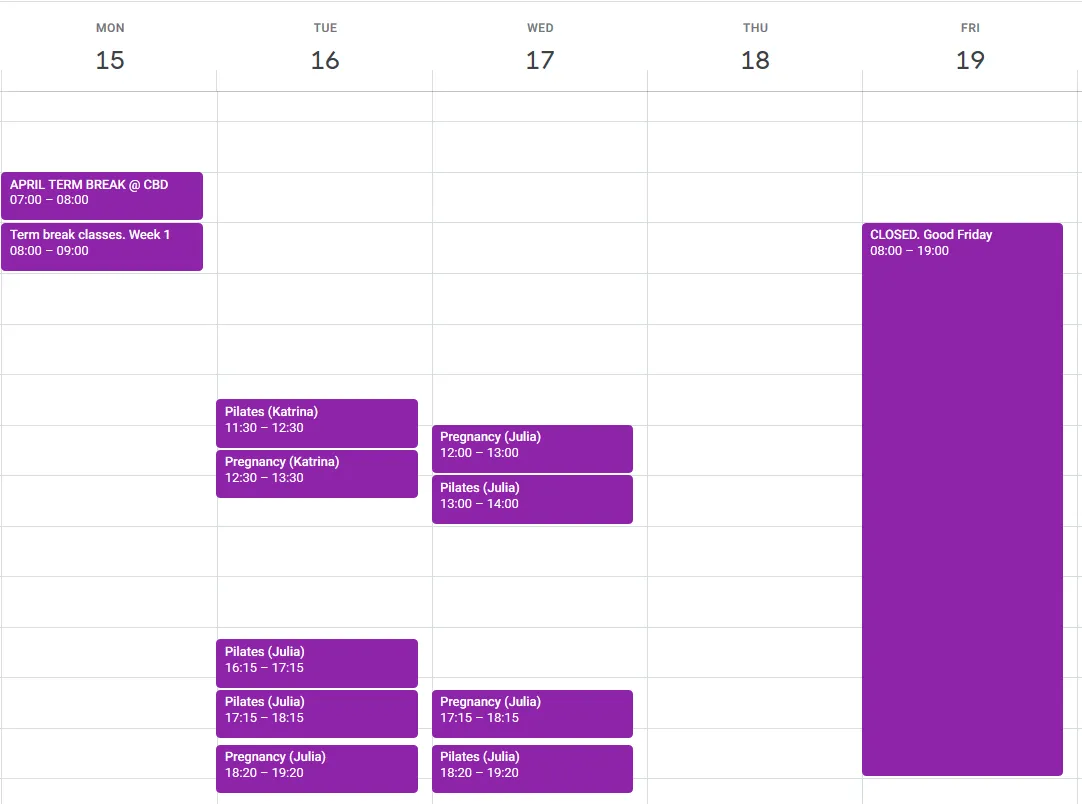
Draft CBD + BROADWAY April 2019 Term break timetable

Draft ‘April term break 2019’. Timetable is subject to change.

These classes will run for 2 WEEKS in our Sydney CBD and Broadway clinics. Classes will commence from the week commencing Monday 15th April. Please note due to Easter and ANZAC holidays, classes are restricted to Tuesdays and Wednesdays only. 

Classes are recommended and scheduled for:

  • Intermediate/advanced  mixed level Pilates for challenging and functional postural control. These classes are suitable for our existing Pilates clientele currently attending our beginners, intermediate or advanced classes in 2018.
  • Pregnancy specific Pilates. These classes are suitable for our existing pregnancy Pilates clientele currently attending our classes, or have been assessed to be ready for these classes.


31 Mar 2019 BY Katrina Tarrant POSTED IN Exercise, Pilates, Pregnancy

Draft CBD term 2 2019 timetable

Draft ‘term 2 2019’ Pilates timetable is subject to change.

These classes will run for 10 WEEKS in our YORK STREET CBD clinic.

Classes will commence from Monday 29th April and end Friday 5th July 2019.

Monday classes will be a 9 week term due to the Labour Day public holiday in June .

Classes for this term at our York Street CBD clinic are recommended and scheduled for:


Draft Ryde term 2 2019 pilates timetable

Draft ‘term 2 2019’ Pilates timetable is subject to change.

We are super excited to offer classes for the first time ever at our new clinic this term.  These classes will run for 10 WEEKS in our RYDE clinic.We hope to soon offer more classes on other days of the week, but come and say hello on a Monday.

Classes will commence from Monday 29th April and end Friday 5th July 2019. Monday classes will be a 9 week term due to the Labour Day public holiday in June .

Classes for this term at our Ryde clinic are recommended and scheduled for:


The Fix Program opens a new clinic in Ryde!

We are thrilled to announce a new clinic opening…just for women in Ryde

Pilates Ryde

On March 25th 2019, we will be opening a brand new clinic at Ryde. We will be located within the beautiful Fernwood Fitness Women’s Gym.

Our passion for the wellness of women will shine on at this new clinic, bringing you all The Fix Program expertise and care. The expertise that has been changing the lives of women since 2005 when we opened our first CBD based clinic.

We will be there with:

  • our physiotherapy services for you. Whether it’s your postural pain or a gym niggle, with our expert physio’s treating you, we’ve got you covered.
  • our specialised women’s health physiotherapists, managing pelvic floor and physical problems unique to women. Incontinence, pelvic pain, sexual pain, pregnancy related issues, post natal rehabilitation, prolapse, and pessary prescription are our forte.
  • our pregnancy physiotherapy services for the best for you and your baby. Helping you through pregnancy with safe and appropriate pregnancy Pilates classes and physiotherapy for pregnancy related pelvic girdle pain, back pain and other aches at this special time.
  • our post natal physiotherapy services with Mums&Bubs Pilates classes, post natal pelvic floor and abdominal separation checks and advice before safely returning to your pre-baby exercise routines.

And this is just the start.

Where are we?

Within the Fernwood Ryde Womens Gym, 84 Belmore Rd, Ryde.

What do I do next if I wish to make an appointment?

Contact us. You don’t need a doctor’s referral to see our physiotherapists. We’ll be happy to chat about your needs, and for the month of April 2019, we are offering 50% off your first visit fees to celebrate our arrival at Ryde.


24 Feb 2019 BY Katrina Tarrant POSTED IN Exercise, Pilates, Pregnancy

Changes to the way we deliver our Pilates classes from April 2019

Choose your class stream for term 2 Pilates programs

As you should be aware and as we outlined in an earlier post in January, there are changes in private health fund rebates for alternative therapies, including Pilates. This decision and reform by the federal government in 2018 comes into effect 1 April 2019. This has meant changes to the way physio clinics across Australia deliver group exercise  to comply with the new rules.

 Luckily for physiotherapist however, we have been permitted (with intense lobbying late 2018) to continue to deliver classes of which Pilates may be a clinically appropriate exercise for an individual. (This sadly is not the case for Pilates studios across Australia, where services for classes or individual sessions taught by non-physios are no longer claimable).

However with this, there are changes to the way we physiotherapists deliver these classes to comply with the claiming process. This will effect your classes, so please consider your options. 

As physiotherapists, we are excited by these changes as we can see a better goal orientated and individualised approach to your rehabilitation in our new small format classes. Individualised exercise for individuals. Targetted for your actual weaknesses and with better outcomes.

Please think about what you are after in attending physio-instructed classes such as ours. With this in mind, please read the table below as we explain the 2 different class streams that we will now offer at The Fix Program.

What do we suggest you do now?

  • Please talk with us more about your concerns and any questions regarding your attendance in classes going forward. Both our admin and physio staff will be able to assist you.
  • Contact you private health fund regarding rebates, quoting our new fee schedule.
  • Decide on which class will be right for you, taking into consideration what you are personally after from our classes, and also the rebates involved.
  • If you are choosing to move to the clinical rehabilitation class stream, please arrange to book your 1 hour assessment. These must be done and your exercises set before the commencement of term 2 2019 on 15th April 2019.  This can be performed by any of our physio staff where they will assess your current goals and clinical picture, set and teach you your exercises and focuses for your classes and get you ready for the new clinical rehabilitation small format classes.

We understand this must be a lot to take in, as it has been for our clinic and all physio clinics around Australia. We are prepared for an adjustment period to get the new class system in place and ask and thank you for your patience during this time.


Fix News