
A physiotherapist’s guide to back packs
Tips on choosing the right back back
Considering that 60-80% of us will experience back pain in our lifetime, choosing the correct back pack for us or our children should be a priority. The high number of children and adolescents already complaining of back pain is astounding. Studies recently in South Australia of 2500 children found half of them repeatedly complained of pain episodes. Victorian studies concluded that 1 in 3 school children suffered back or upper neck pain, caused by heavy schoolbags.
Providing a good back pack to everyone is crucial, and educating on its proper use vital.
Here’s the physio’s guide to choosing a good back pack.
- Make sure it is appropriately sized for you. It should neither extend past your shoulders when sitting down with it, nor be wider than your chest.
- Be comparatively lightweight. Fully packed it shouldn’t weigh more than 10% of the your body weight.
- Be sturdy and reasonably water-resistant (or have a rain cover). The material should be firm to prevent sagging. The base should be abrasive-resistant and/or reinforced.
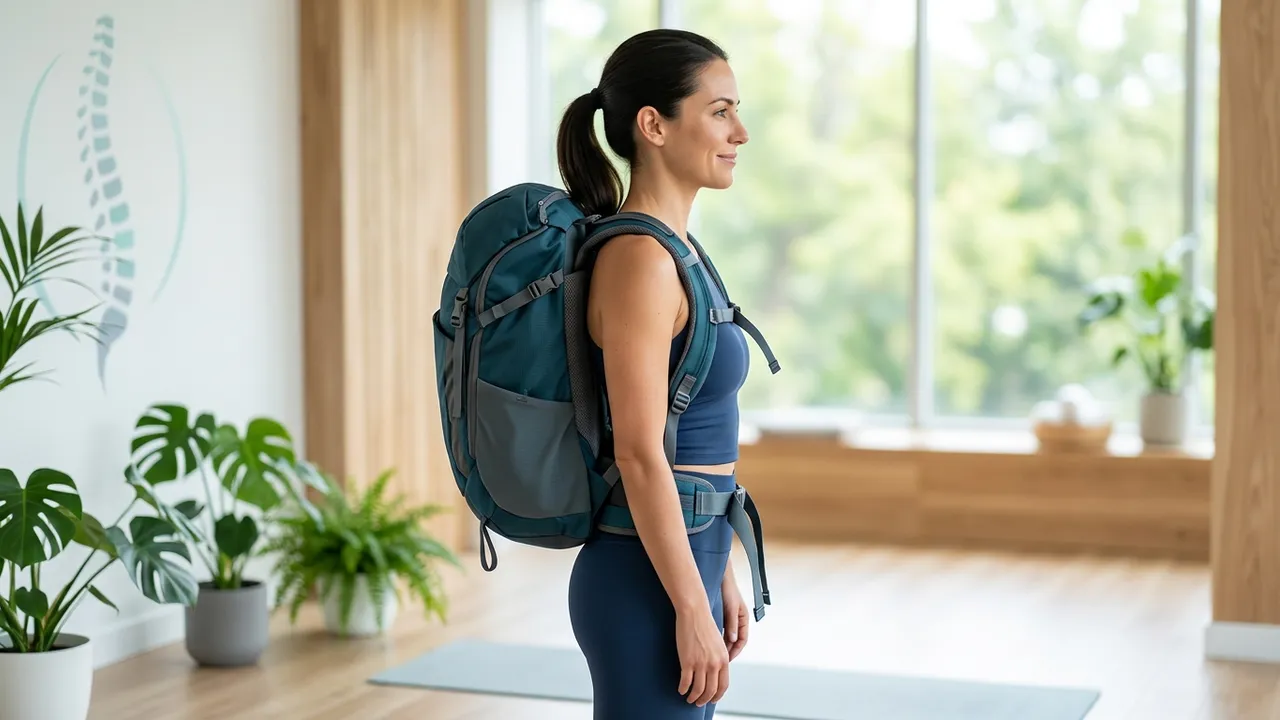
- Have a moulded frame and/or an adjustable hip or waist strap, so most of the weight rests on your hips and pelvis, not on your shoulders and spine. The waist/hip belt is particularly important to secure the load when walking, running or cycling.
- Have adjustable, broad, padded shoulder straps that help distribute the weight evenly across your shoulders and and don’t dig into you.
- Have a padded or quilted back for comfortable wear.
- Have compression straps at the sides to draw the load together and bring it close to your back. They’ll also help stabilise the contents of a partially filled pack.
- Have a sternum (chest) strap to help stabilise the load and prevent the straps slipping off the shoulders. It should sit about 10 cm down from the Adam’s apple.
- Have several pockets to help with even weight distribution and organisation inside. A drink bottle holder on the side keeps potential spillages outside the pack.
So, now that you have the right back pack, here’s how to use it properly.
- Backpacks are designed to carry a load safely — symmetrical, stable and close to the spine — but not if they’re worn casually slung over just one shoulder.
- Put it on safely. Try to lift it up by the loop with both hands and bent knees, facing the straps and pushing up with the legs. Place one strap over the shoulder, then the other, or put it on the edge of a desk and loop both arms through together.
- A backpack should be worn so the waist strap (or hip belt) sits firmly where intended.
- Shoulder straps should be adjusted so that you don’t have to lean forward and the base of the pack rests on their hips, not on the bum.
- Pack your back pack properly. Items shouldn’t be able to move around; the heaviest ones should be packed closest to your back to reduce stress on the spine, lighter items away from the spine.
- Pack only what you need to keep the weight down.
The Australian Physiotherapy Association (APA) endorse a back pack for children. Called the PhysioPak, it meets the standards of the APA. With multi-adjustment straps at the shoulders, waist and chest, and a moulded back that rests well and at the correct angle to the spine. See http://www.spartanss.com.au for further details.
For more information please contact us
Struggling to find the right exercise?
Lost focus?
Do you ever feel that your exercise really isn’t grabbing you? Are you bored with it? Not looking forward to the next session? Making excuses to avoid exercising altogether? We are all individuals and therefore the gym/running/getting sweaty is not for us all.
So we all know the well documented benefits of exercise. From heart and vascular health, to muscle strength, reduced pains, improved sleep patterns, and a happier mind. So why do the majority of us not find these reasons for exercise inherently motivating?
Perhaps some of these reasons sound like you? If you are struggling with a regular exercise routine and you acknowledge one of these reasons, make a change.
- Motivation is waning.
If you just don’t feel like exercising and the enjoyment is not there, you will never want to exercise. Convenience sometimes is not enough. Make the effort to find what’s right for you, and not everyone else.
- Clock watching
If you can’t get yourself finishing your workout quick enough, then the enjoyment is not there. Not only that, you are risking injury and perhaps not the best out of your workout, especially if you are using weights.
- Tired all of the time
Regular exercise should give you more energy, not less. Perhaps you are pushing yourself too hard, or it is just not the right exercise for your physical and mental wellbeing.
- I’m bored
Just because your friends are loving the gym, or their yoga DVD or Pilates class, doesn’t mean you will. Getting that endorphin rush after exercise is different for us all. Perhaps it’s dance classes, BMX riding, bush walking or skate boarding with friends. This all counts as exercise and the benefits will be the same.
- Exercise is always the same
Perhaps you have been doing the same workout for as long as you can remember. Like anything, routines can become stale. Interest and motivation are sure to decrease and time is wasted as the benefits of your exercise are also decreased.
So if you are dreaming of bacon when you are exercising, perhaps your focus has been lost.
Pop on your thinking caps, find a new exercise and keep your body on your toes.
Michelle Bridges and The Fix Program for Pregnancy
Katrina spends a day in front of the camera for 12WBT
This September saw 12 Week Body Transformation launch 2 new programs – for pregnancy and post-natal. 12WBT has more of a reputation around working out, weight loss and adopting a positive long term outlook to well being, lifestyle and exercise. The pregnancy and post-natal programs are more about maintaining a healthy, active but appropriate level of exercise and nutrition at these special times in a woman’s life. Yours truly was contacted by the 12WBT team and asked whether I would happily part with the knowledge and expertise we have here at The Fix Program when it comes to exercise in pregnancy and early post-bub days.
I was preened and tweeked and interviewed in front of camera, and from this 2 videos have been released. These unfortunately are only for the 12WBT program subscribers, but if you really want to see them, do be in touch.
What were the big messages that I emphasised for pregnant women and exercise?
- Listen to your body – now is not the time to get fit, take up running your first marathon, or pushing heavy weights about.
- Obtain the medical all clear from your doctor before exercise.
- Pelvic floor muscles first. Be aware or their very important role and remember that they are very tired within pregnancy. Learn to activate them correctly, and to know how to also give them a rest ( or to let go). Avoid high impact exercise when down there is already very loaded and tired.
- Postural awareness and the massive changes on the spine, pelvis and hips in pregnancy. Take the time to ‘set’ your posture (such as pelvis neutral and waists tall) and move more slowly in exercise. It’s not about racing, it’s about being safe.
- Remember the effects of pregnancy hormones such as relaxin and keep movements controlled. Try to avoid jerky movements or bouncing at the very end of a stretch. Your joints may not cope with this extra elasticity and get injured. This is particularly so about the pelvic joints – your pubic bone and sacral joints in your buttocks.
- The big no-nos. Never exercise and seek immediate medical opinion if you are having vaginal bleeding, shortness of breath, decreased foetal of baby movements, high levels of pelvic and/or back pain.
What were the big messages for new mums and being safe in exercise?
- Obtain the medical clearance after having baby for you to start up exercise.
- Give your body at least 8 weeks to recover from your labour, whether you had a vaginal or C-section birth. If you had a high intervention birth with stitches, forceps and vacuum, you may even need longer. Seek advice
- Pelvic floor strength and control first. Your pelvic floor needs time to regain some strength. It is tired and sometimes traumatised. Appropriate pelvic floor exercises learned and practiced daily is essential before embarking on medium to high impact exercise. Start these in those early days. Forget the jogging for at least 4-5 months until you have your strength (and lift) through these muscles back.
- Avoiding prolapse and ongoing pelvic floor issues is best prevented, not cured.
- Postural awareness is again essential. Your body is now getting used to not having a belly bump, so take the time to ‘set’ your postures in your day – when exercising, feeding, carrying, sitting, or pushing the pram.
- Give yourself time and don’t be hard on yourself to get your pre-baby body back tomorrow. It takes up to one full year to address your postures, pelvic floor muscle control, reduce abdominal separation and start to lose your pregnancy weight.
- You will be tired, so do a little when you can. On the floor with bub for 5 minutes. Here are some basic mat exercises for your pelvic floor, pelvic control, stretching. All will help.
All in all, it was a great experience and my relationship with 12WBT will continue as I head up some guest posts for their blog, the first is here on pregnancy incontinence. Don’t worry. Although it was amazing to feel a bit special and in the limelight, it wasn’t as great as being here at the clinic teaching all of you guys!
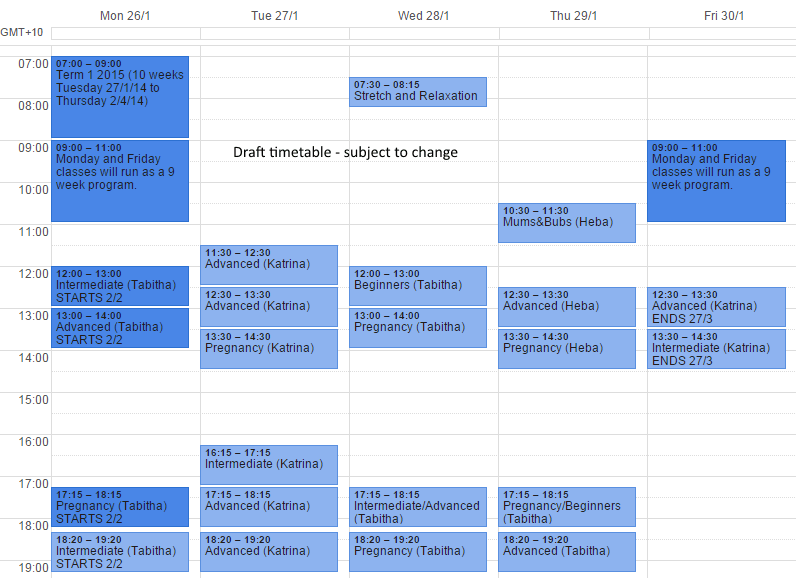
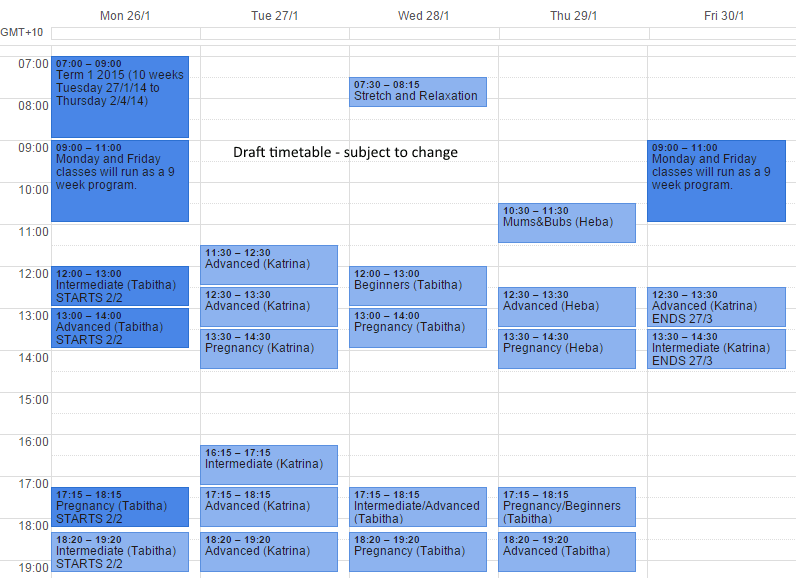
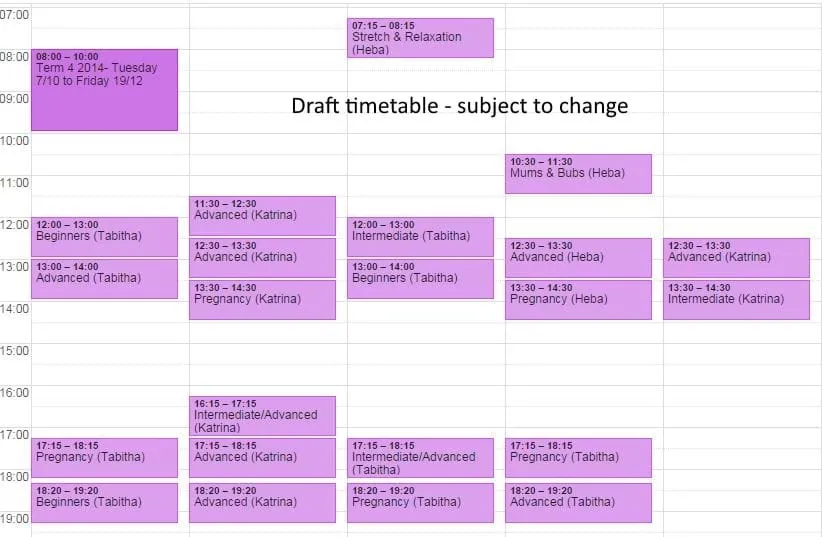
Draft Pilates Timetable Term 4 2014
Orthotics for my running niggles
Katrina shares her experience with podiatrist Lance Penn
OK, so l’m a physio and should practice what I preach. Hmmm…well.
I’ve got to be honest and have always been resistant to wearing orthotics, however with an increasing enjoyment for pounding the pavement, I am starting to notice that I perhaps don’t spring about with young joints anymore. A little niggle here in this toe, a little niggle there in that hip, a calf injury that has sidelined me from running for a week here and a fortnight there. Perhaps it was time to explore what orthotics can do for me, seeing as though I kind of felt that all of these injuries were related to my feet. Not to forget that mechanics of the feet will also effect further up the chain, such as the knee, hip and lower back.
I’ve never felt that I could put up with a hard rigid orthotic propping my arch inside my shoes, so was happy to hear that orthoses are now moving towards a softer, more giving material. The new treatment paradigm for podiatry is to not look at only the degree of high or flat arches ( poor pronation or over pronation), but to diagnose where structures in the foot are overloaded and therefore sore, and redistribute the forces more widely or evenly across the foot. Makes sense and boy, I really liked this thinking. After all, this is what I do every day when diagnosing and managing back, neck and hip pains in my clientele.
I was assessed via video, treadmill and force plates to obtain an accurate picture of what was going on at each foot. OK, so my right foot rolls in a little too much at the arch, but the bigger problem was that I failed to use my forefoot (the front of my foot) and big toe properly. It’s really quiet amazing to see what happens at your foot during its time in contact with the ground (and in slow motion too). Digital measurements available today with the technology about mean perfect prescription of your orthotic moulds and the finished product.
So, my orthotic does not hold me rigidly to prevent me from rolling in on the arch. After all, pronation, or rolling inward at the arch of the ankle is a normal and necessary movement of the foot to absorb loads before pushing off. My orthotics in fact encourage the pronation and have more of a support dome in the front foot.
And how am I doing wearing the orthotics? Well I still have to slowly build my tolerance to wearing them for my running. They feel very different in my shoe compared to the manufacturer’s inner sole, but to be honest, after wearing them for an hour or so, I don’t even notice it. I have to continually remind myself that this foot position is something unfamiliar to me and my foot, so to give it time. I am struggling to wear them for all my running, especially my longer runs due to blistering under my arch. I can wear them for short distances and to wear them all day such as on the weekend is not trouble at all.
As a part of the orthotic prescription process, I am due to revisit Lance the podiatrist again now to chat about the fit and the difficulties in wearing them for my longer runs. I will follow up on these coming weeks.
But, to say I am a convert is not exaggerated. The new treatment approach to disperse forces rather than rigidly fix a foot is very agreeable to the body and it’s mechanics. And I am certainly noticing the difference to my body’s little niggles.
What is stress urinary incontinence?
Discover what causes those “embarrassing leaks”
Do you leak a little whenever you cough or sneeze or laugh? Or maybe you only leak when your bladder is full and then you cough or sneeze? Perhaps you notice some leaking during sex or when you’re exercising – it may be during star jumps, jumping on the trampoline, going for a run or whenever you lift heavy weights, even lifting children or heavy shopping bags?
If you’ve answered yes to any of these questions, you likely have stress urinary incontinence (SUI). SUI is triggered by an increase in the pressure in your abdomen, such as with a cough, a sneeze, a laugh or exercise, which then puts increased pressure on your bladder and on your urethra, causing a small leak.
If you do have SUI, you are not alone. SUI affects 30-50% of women; no matter how old they are – although it is more common after pregnancy and after menopause. This means every second or third woman you know probably leaks a little too! Even though SUI is so common, it certainly is not “normal”. Interestingly, men can also develop SUI – but this is usually only if they’ve had prostate surgery. The great thing is, SUI can often be managed with pelvic floor strength and coordination exercises with your women’s health (or men’s health) physiotherapist. But there are some cases where a minimally-invasive surgery may be needed.
Can I stop leaking with stronger pelvic floor muscles?
When we think of stress incontinence, often we immediately think that our pelvic floor muscles must be very weak. So if we have a leak we start practicing our pelvic floor muscle exercises in the hopes that the exercises should stop any incontinence. And sometimes pelvic floor strengthening work really does help. But sometimes it doesn’t. Sometimes we get frustrated because we’ve been practicing and practicing but we just keep leaking. This is why we need to understand WHY we are leaking to really address the issue and decide which treatment will be best.
The 3 types of stress urinary incontinence
There are three main types of SUI and sometimes you can have 2 different types taking place at the same time.
Type 1 and Type 2 SUI are due to urethral hypermobility. This relates to the support of the urethra and involves the pelvic floor muscles as well as the connective tissue inside the pelvis. Imagine the connective tissue to be like tight elastic bands that hold the bladder, uterus and bowel in their places inside the pelvis. These tight elastic bands hold the organs to the top of the pelvis, to the sides of the pelvis, to the front and back of the pelvis – there’s tight elastic bands everywhere even between the organs and between the urethra and vagina.
There is a sheet of elastic tissue that goes between the pubic bone towards the vagina and completely surrounds the urethra. It is the highlighted bit in the picture above. In SUI this connective tissue is damaged and so rather than holding tight when there is a high pressure (such as a cough or sneeze) the tissue sags, which then makes the urethra drop usually taking the bladder neck with it. This extra movement of the urethra allows for a small amount of urine to escape just at the time of the increased pressure of the cough or sneeze.
In milder cases of SUI due to urethral hypermobility, pelvic floor strength and coordination exercises will help. You can coordinate your pelvic floor to squeeze and lift very strongly and tightly just before the cough and sneeze. This is called The Knack. The pelvic floor muscle supports the urethra by tensioning another sheet of connective tissue to stop any urine from escaping.
Your women’s health physiotherapist can prescribe exercises for you. Sometimes a support device called a pessary can be inserted vaginally to support the urethra – these can be fitted by your women’s health physiotherapist. In some cases, a key-hole surgery may be required to insert a mesh sling to hold the urethra in place to prevent the hypermobility – essentially replacing the role of the sagging connective tissue. This is called a TVT or a TOT. Your women’s health physiotherapist will refer you to a gynaecologist if this is required.
Type 3 SUI is due to urethral sphincter deficiency. In the picture below we can see that the urethra has an internal urethral sphincter and an external urethral sphincter, which act to keep the urethra closed. These sphincters are made of muscle, and with age and particularly after menopause there can be a loss of muscle fibres in the urethra, which can leave the urethra open. There can also be changes to the nerves or blood supply to the urethra with age.
During birth, if the delivery involved instruments such as forceps, there can be some nerve damage which can lead to urethral sphincter deficiency. Previous surgery in the area can also increase the likelihood that it is Type 3 SUI, as there can be nerve or blood supply changes. This is the type of SUI usually found in men after prostate surgery.
Type 3 SUI cannot be completely treated with physiotherapy but can certainly be diagnosed by a women’s health physiotherapist. If your physiotherapist believes you have a sphincter issue, you will be referred on to a gynaecologist. Treatment usually involves injecting bulking agents into the urethra to increase the muscle fibres or using medications that can improve the nerve supply or vaginal oestrogen to improve blood supply or nerve regeneration. In some women, a TVT operation will help.
Now that you know WHY you are leaking and HOW stress incontinence occurs you can better understand when pelvic floor exercises can help and when they are not enough. SUI is multifactorial – yes there may be some muscle involvement (which is when pelvic floor muscle exercises do help) but there can also be issues with the connective supporting tissue or with the urethra itself. If you have SUI it is important to know whether it is a urethral hypermobility issue or whether it is an intrinsic sphincter deficiency or whether you have both. Your women’s health physiotherapist can help you figure out which it is and advise you of the appropriate treatment.
Ballet, Strength and Movement Precision
Exercise ‘specificity’ at its best
Watching this youtube clip showing dancers in slow motion makes you realise how perfect these skilled dancers are in their movement and movement control. What is even more interesting is how precise and targeted the strengthening exercises are to exactly target that very movement and the muscles involved. This includes all muscles from the spinal stabilisers, to the joint stabilisers to the lever muscles of power.
What a perfect example of ‘training specificity’. This is the way in which exercises can be tailored to precisely strengthen the muscles you need for a particular activity. As exercise therapists (us) and those interested in exercise and staying healthy and strong (you), we should all look for better ways to make our strengthening and exercise more specific.
Your imagination is all you need.
How orthotics reduce pain in injury
Podiatrist Lance Penn from Footsport guest posts
An orthotic is a custom made device designed to off load abnormal forces that can lead to damage of soft tissue structures, joints and bones.
What causes injury?
The direct cause of pain is a consequence of damage to the body (muscle/tendon/ligament/joint) as a result of abnormal forces. If the body cannot adapt to these loads then injury occurs. Physiotherapy principles aim to strengthen and or stretch tendon/muscular structures so that they can cope with the abnormal loads. Ideally, physiotherapy aims to achieve removal of the overloading forces directly from the sore tissues by spreading the abnormal forces more evenly about the area.
Orthotics work by altering abnormal loads around the joint axis, thus reducing the stress on the tissue. The best course of treatment is to tackle it from
both sides, strengthen/stretch and off load.
Certain feet are prone to over loading forces and this has nothing to do with the arch height. We now know that ‘flat feet’ are at no greater risk of injury than a ‘normal arch’. Traditionally foot assessments were based all around motion. Excessive inwards roll or ‘over pronation’ was presented as the root of all evil. This model of assessment has more or less been debunked. Current understanding is based around forces especially abnormal forces, and how they fit in with motion.
We still are not clear why some feet exert over loading forces while some do not and there is no link between over load and flat feet.
At Footpoint during our comprehensive biomechanical assessment we are able to identify the foot types that have abnormal loading forces and thus prescribe the correct orthotic that will reduce these forces. Pronation (or rolling in of the arch) is normal and in many cases we are trying to promote the natural ability of the foot to pronate. Most of our orthotics prescribed are flexible and always comfortable as we use the most up to date scanning technology that captures an accurate cast from which the orthotics are moulded to.
The orthotic process starts with the biomechanical assessment, casting then prescription of the orthotic. Once we fit the device we review you 6 weeks later to assess for the need to optimise the orthoses. This is part of the customisation process as fine tuning is needed to optimise function and comfort.
Orthotic customisation has come along away and we pride ourselves with having a comprehensive process that allows for easy communication and delivery of great clinical outcomes.
To find out more about Lance and his amazing orthotics, visit http://www.footsportpodiatry.com.au/ or call 9231 2707.
Paracetamol and lower back pain
Ineffective? I say misleading.
You may have recently heard in the mainstream media that there is a big question hanging over the effectiveness of Paracetamol in the management of early back pain. This was based on a very recent study by Australian team of scientists who were published in the highly reputable journal, The Lancet. The link in this post about this study is to a newspaper article written in the UK about the findings.
http://m.nursingtimes.net/5073407.article
As a little background to all of this, it has been recently found and become an International medical guideline that with early lower back pain, the best course of treatment is to take simple and regular Paracetamol and keep moving, or stay as active as you can.
This new research challenges these guidelines and asks for further research and trials into the effectiveness of Paracetamol. However, in my opinion, this news really needs to be interpreted very carefully.
Here is why…
Firstly to this article’s title and the comments from the study’s authors that simple pain medication ‘does not work’ for lower back pain. To state that this is the case has me all but a little concerned. How very misleading. The actual study found that in those with mild to moderate lower back pain taking part in the study, there was little difference in return to pain free function between groups taking Paracetamol and those taking a placebo tablet. Both worked and had good rates of recovery. Here are the details of the main findings:
- The number of days to recovery in the Paracetamol group was 17 days, and the placebo group, 16 days.
- By 12 weeks, sustained recovery (not needing further management) had occurred in 85% of the Paracetamol group and 84% in the placebo group.
OK, so there is not much difference in the 2 groups, but
- Would you say that these results indicate that Paracetamol is NOT effective? Certainly not.
- Would you NOT consider taking the advice from your GP to take Paracetamol with an attack of back pain based on these results? Certainly not.
OK, so taking a placebo has the same effect. In my opinion, the main question (and an exciting one) to come out of these findings is this.
What is at work here when pain reduces and function increases equally in groups taking real medications and placebos?
My thoughts? As we discover more and more about the human pain response and see its complexity, explaining phenomenon like placebo effects becomes a little easier. As we are discovering, pain is a complex output system from the brain and involves brain centres of emotion, memory, movement and sensory (to name a few). There is a saying going around that translates to something like this:
‘If the brain thinks that you are doing enough to help to get better, then that is often enough.’
We are increasingly seeing that other ‘psychosocial factors’ predict good outcomes from injury and responses to pain. These can include ethics and belief systems about pain and exercise, confidence in health practitioners, positive outlooks to injury and life generally, socioeconomic status, happiness in the workplace, relationship happiness and general health and wellbeing. The list goes on and on.
So back to the study. I personally could hypothesise that there has been a list of probable factors influencing the similar rates to recovery in both placebo and Paracetamol groups. This could start with seeing a confident well spoken doctor with a clear management course communicated for the lower back pain attack. A simple and uncomplicated message involving a simple pill and the advice to ‘keep moving’. This instils confidence in the injured. Keeping as active as possible keeps the movement or motor centre in the brain functioning well and therefore feeding healthy impulses about the brain. As pain starts to ease after those first few days and movement becomes easier, ‘happy hormones’ and natural occurring pain endorphins kick in more, further speeding up the road to recovery.
And on it goes…
To say that Paracetamol is ineffective in managing early lower back pain is misleading. It would be fairer to ask by what means is the tablet you are taking making an effect.
Showing 10 of 293 articles by Katrina Tarrant