
The Fix Program Blog

15 Sept 2016 BY Katrina Tarrant POSTED IN Physiotherapy

Rewire your brain to embrace change by Kimberly Gillan

A great read about the brain’s ability to behave with plasticity, to learn and attempt new things and make these entrenched as a new habits.


How many times have you sworn to eat perfectly healthy this week or finally make the career leap you’ve been dreaming of, only to get distracted by Netflix and a junk food binge?

Before you write yourself off as hopeless, it’s worth considering the fact that there are some interesting biological factors at play, designed to keep us in our comfort zone and avoid “out there” new behaviours. But with some clever strategies and persistence, you can override your brain’s penchant for comfort zone living and start to craft your ideal life.

Why we hate change

Ever stuck with the same old boring schedule, despite knowing there might be more exciting avenues to pursue? Well you’ve got your own biology there to blame. Basically, our brain favours us cruising along in a safe way. If we’ve got access to food and shelter, our brain kicks back thinking things are going swimmingly.

But when our prefrontal cortex (the part of the brain responsible for conscious thought and goal-setting) has a lightbulb moment, the other parts of the brain can go into damage control. This is to try preventing the potentially dangerous interference with everyday life.

“Often the brain detects things that are different from what it’s used to as a potential threat,” says Nikki Rickard, Director of Psychology, Swinburne Online. “If something is out of whack, it registers fear and will trigger what we call the flight-fight response, which is preparing your body to avoid or go and attack the source of the fear.”

One part of the brain that’s always quick to fire up about change is the amygdala, which detects threats.

Pushing out of the comfort zone

You’ve probably noticed that the more often you do something like a 6am gym class, the easier it becomes to do.

“When a behaviour has been repeated over a long time, the brain economises and works out a quicker way of doing things that requires less effort and tires us less,” Rickard explains.”It becomes a well-worn pathway so the brain can almost do it automatically and free up higher parts of the brain to handle more complex things we need to think about. The neural pathways become more solid.”

While it was once widely believed that our brains had limited capacity for change after adolescence, continued research, and Dr Norman Doidge’s seminal book The Brain That Changes Itself has revealed that we can open up new pathways in our brains to change behaviour — with commitment and persistence. Meaning that while opting to wake up earlier, study harder or work later may seem impossible at first, dedication will reward you by making the task easier over time.

“You’ve got to commit to the intention and believe you’ve got control over it,” says Rickard. “How much effort, time, patience and focused attention you can put into that new behaviour will determine how quickly you can unlearn the old behaviour and learn a new one.”

Helping new habits stick

If you can override that fear response and push through with your new routine, whether it’s 5am workouts or online study, then the basal ganglia part of the brain will start to take over and make the new behaviour a habit.

“When it becomes automatic, like riding a bike or driving a car, that’s when the basal ganglia and other more primitive parts of the brain take over,” Rickard explains.

You might have heard that it takes 21 days to form a habit, but research shows that it varies drastically between individuals and depends on the habit they’re trying to form. In fact, some researchers found it takes people anywhere between 18 days and 254 to cement a new habit.

But regardless of how long it takes, Rickard says that the more frequently you change your routine or life, the easier your brain will cope with change.

“People who are flexible and have tried a few times to break a bad habit and have been successful get rewarded for that,” Rickard says.”[Habits] are quite hard to learn but once they’re in [the brain], you slip into them almost without being aware — it becomes an automatic thing that happens.”

Trying different ways of doing things — changing the routine, with different people, or in different places — can often remove some of the cues that trigger old habits, and help you begin the rewiring that builds a new healthier behaviour.


Wow! Is this how I do a ‘Kegel’ pelvic floor contraction properly?

Pebbles falling into ponds will get you doing it right!


Pelvic floor strengthening or ‘Kegels exercise’   has recently hit the mainstream gyms and news. The importance of the pelvic floor is finally  being realised more, which is a great thing. It not only keeps our bladder and bowel control in check, but it also helps us with sex, supports our pelvic organs and gives our spine and pelvis great support. Yes, it is one of the ‘core muscles’.

However, doing it right may not be the easiest.

There are many tips to make Kegels exercises better or more appropriate. Try our ‘pebble in the pond’ method to have you contracting your pelvic floor with targeted appropriateness! 

Are you contracting your pelvic floor correctly?  

The pelvic floor can be thought of as a hammock at the base of your pelvis, connecting your pubic and tail bones. It incorporates the muscles that are part of your urethra, vagina and back passage. It does NOT involve your buttock, inner or front hip muscles, so isolating the contraction to only the hammock is the trick. It is also the way to get the best out of your pelvic floor strengthening.  

To help with this, picture the falling pebble into the pond.

‘Picture a still pond and a pebble falling into its centre. Visualise the circles of ripples this makes spreading slowly out to the edges of the pond.  Now rewind this picture, so you can see the ripples moving back evenly to the centre of the pond and the pebble lifting out of the water.’

Now try to relax and then contract your pelvic floor hammock in this way.  Can you feel how this image beautifully depicts the relaxing of your pelvic floor (dropping the pebble) and contracting (lifting the pebble) of your pelvic floor hammock?

Have you kept your buttocks and hips soft and isolated the contraction better to the vagina and back passage?

Make it a new habit!

Quietly lying on your back with your knees bent or sitting comfortably, imagine this picture as you very gently activate your pelvic floor muscles. Check that you

  • don’t try too hard – just begin with a small and easy contraction
  • keep your buttocks soft and relaxed
  • keep breathing. Please, no breath holding!

When you feel you have mastered this contraction, make each and every pelvic floor contraction feel this way. Remember, ‘close’ then ‘lift’ subtly when:

  • At the gym, yoga or Pilates classes.
  • Lifting weight, both at home with the washing basket or at the gym.
  • You feel a cough or sneeze coming on to prevent embarrassing leaks.
  • You are getting your pelvic floor strong again after having your baby.

Contact us if you wish to chat more about your pelvic floor muscle function and control.


13 Sept 2016 BY Katrina Tarrant POSTED IN Pilates, Sydney CBD

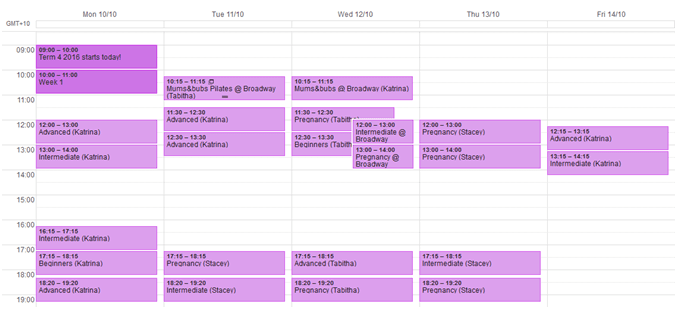
Draft Term 4 2016 timetable

Draft term 4 timetable is subject to change. This timetable is for our all of existing and NEW Pilates clients. These classes will run for 11 WEEKS for all classes on Monday- Thursday, or 10 WEEKS for all Friday classes.

Term 4 commences on Monday 10th October, and ends Thursday 22nd December.

Classes are recommended and scheduled for:


2 Sept 2016 BY Katrina Tarrant POSTED IN Exercise, Pilates, Pregnancy

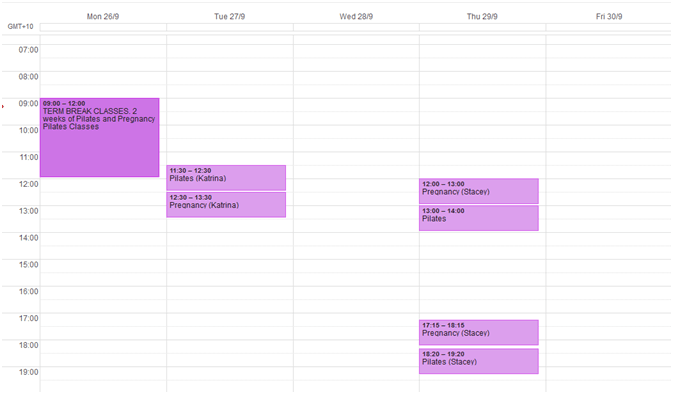
Draft October 2016 ‘term break’ timetable

Draft term break timetable is subject to change. This timetable is for our existing Pilates clients who do not wish to break between our Term 3 and Term 4 10 week programs. These term break classes run for 2 WEEKS ONLY and will run straight to our Term 4 commencement date of Monday 10th October.

Classes are recommended and scheduled for:


3 Aug 2016 BY Heba Shaheed POSTED IN Pregnancy, Women's Health

Pelvic floor muscle injury in labour

Recovering after 3rd and 4th Degree Tears

Baby on chest

Unfortunately, during birth, women can experience perineal tearing. The perineum is the area between the vaginal opening and the back passage. A woman can suffer from varying degrees of tearing, with some short term, but also long term effects on pelvic floor function. This can include bowel and bladder issues or ongoing pain. The worse of these tears are called 3rd & 4th degree perineal tears are also known as Obstetric Anal Sphincter Injuries (OASIS), because the perineal tear extends into the anus.

Tear pic

The varying tears are grouped according to the extent or length of the tear:

  • First degree tears — small skin deep tears which heal naturally
  • Second degree tears — deeper tears affecting the muscles of the perineum. These are usually repaired with stitches.
  • Third degree tears — deeper tears that involve the anal sphincter muscles.
  • Fourth degree tears — tears extending further up the anus into the rectum

Some long terms effects of perineal tears and OASIS can include:

  • bowel urgency
  • difficulty controlling wind
  • difficulty controlling bowel matter
  • painful sex

What can I do if I have suffered from a perineal tear?

After 6 weeks, and once the perineal area has healed you can begin to do some exercises to strengthen the area and reduce or prevent anal incontinence. You will usually have a pelvic floor or women’s health physio helping and guiding you along the way, and they will teach you the following exercise types. Mind the anus chat to come!

Pelvic Floor Exercises with an Anal Cue

These anal sphincter muscles need to be retrained as part of your pelvic floor, because the perineal injury can cause them to become lazy or switch off. It is easy to focus on this part of the pelvic floor sling. Lying on your back with a neutral pelvis

  • Breathe in to relax your pelvic floor down.

  • Breathe out as you squeeze and lift your pelvic floor muscles focussing on the anus being pulled up towards your lower back.

  • Breathe in to relax the pelvic floor muscles back down.

  • Repeat 10 times.

  • Repeat another set in active neutral sitting.

  • Repeat another set in active neutral standing.

Cue

Pelvic Floor Elevator with an Anal Cue

You need to be able to control these muscles at different points so that you are able to control your wind and bowel movements and prevent accidental leaks or accidents. Visualise your anal canal (from your anus to your rectum to the centre of the dimples in your lower back) as 3-storey building with an elevator in it.

  • Tighten your anus and pull it up a third of the way — bring the elevator from Ground Floor to Level 1.

  • Tighten your anus further and pull it up two thirds of the way — bring the elevator to Level 2.

  • Tighten your anus as much as you can and pull it up all the way — bring the elevator to the Roof.

  • Slowly release the elevator down to Level 2, then Level 1 and back down to Ground Floor.

  • Repeat 3 times.

Anus Quick Flicks

You need your anal sphincter muscles to get stronger in their fast-twitch fibres and especially down at the exit, to help you overcome or manage bowel urgency. Visualise the anus at the exit of your bottom as a circular muscle. Imagine trying to pull up a pea through the anus just 3 mm and back out again.

  • Do 10 quick flicks as fast as you can in a pulsing manner as you tighten the circular anus closed and release again.

I need more help…

If you have suffered from a perineal tear after birth, it is important to see a trained women’s health physiotherapist as she can help prescribe even more specific exercises, as well as help you to heal from the injury faster.

Women’s health physiotherapists at The Fix Program physios will help you recover from any birth issues, and perineal tears often require gentle scar tissue massage to release the tissues and muscles that can tighten up after tears. If you are experiencing any bowel issues, your women’s health physiotherapist will help you overcome these issues.

Research shows physiotherapy for just 2 months can significantly improve anal sphincter control and strength to minimize or prevent any wind or fecal incontinence. Your physiotherapist will also discuss important bowel habits advice with you and prescribe you individualized exercises.


The importance of the diaphragm.

Why how you breathe matters!

Anyone who has spent enough time learning about exercise and mindfulness or meditation, comes across a rather strange idea - that there is more than one way to breathe. Most of the time we don’t think about breathing, our body breathes on its own without us having to tell it how! But knowing the full story behind “diaphragm breathing” will help you get deeper and more relaxed breathing, and will help you support your body in a safe, protective posture.

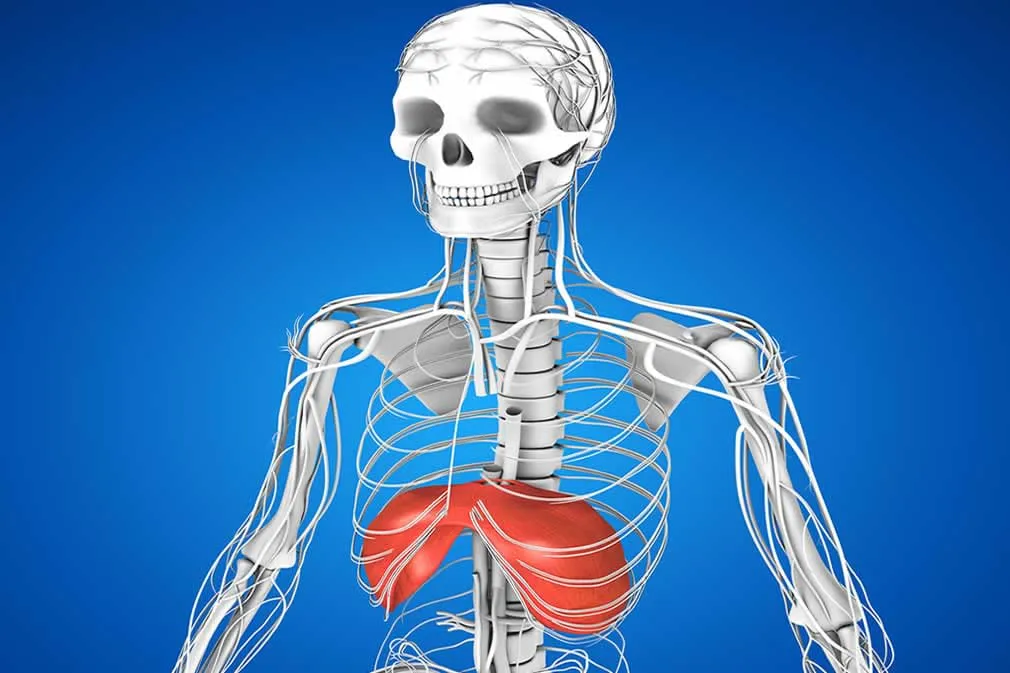
What does the diaphragm actually look like inside my rib cage?

The diaphragm is a dome-shaped sheet of muscle which joins into the lowest few ribs, internally dividing the chest cavity from the abdominal cavity below. When it contracts it pulls itself down towards the bottom of the ribcage, causing the lungs to expand and fill with air. So, while you feel your chest go in and out while you breathe normally, this is not the primary way your lungs fill up - the internal motion of your diaphragm is actually doing most of the work.

Did you know that the diaphragm actually supports your posture too?

Your diaphragm works as the top of the deep system of core muscles surrounding your abdomen, with the pelvic floor at the bottom, the multifidus muscle at the back near your spine, and the transversus abdominus, or deep abdominal layer on the sides. This set of muscles forms a cylinder deep inside your midsection (your “deep corset”), working to support and stabilise the area and protect against injury.

An easy way to breathe better using your diaphragm

While the diaphragm is essential for all breathing, other muscles can get involved and get our bodies into bad habits. These can include the neck muscles creating increased neck tension, shoulder and chest muscles, closing the chest posture or the belly muscles. What we are going to focus on is making sure that the diaphragm is doing the right amount of work in the right way.

  • Place your hands on your lower ribs and take in some deep breaths, just to feel how they move when you breathe normally.
  • Then try and keep taking those deep breaths, only now try and keep your ribs from moving back-to-front, letting them mostly just move side-to-side, feeling how they return close to the centre again when you exhale.
  • As you continue, see if you can minimise any changes to your back arch. When breathing with the diaphragm, no increase in your arch should be necessary. Just widening of the ribs into the side-seams of your shirt.
  • Check that the neck is be able to stay soft and relaxed as well, reducing any unnecessary effort in the process of deep breathing.

How often do you think you breathe like this throughout your busy life? Bringing this peaceful kind of breathing into your waking life is going to help keep your body stable and happier.

How does my breathing coordinate with the other core muscles?

Your pelvic floor should mirror the movement of your diaphragm. It is great to try to remember that

  • when you inhale and the diaphragm lowers, your pelvic floor should relax and drop, and
  • as you exhale and the diaphragm lifts, the pelvic floor muscles should also tighten and lift:

This can take a bit of practice, but it is the best way to make sure that “deep corset” of yours is working as effectively as it can. Try taking five deep breaths in a row, practising your coordination of diaphragm breath with the deep pelvic floor contraction and relaxation.

Now try also gently drawing in the lower abdomen with the exhales as well, making the sides of your deep corset or cylinder work together with the top and bottom. Try this fully coordinated breathing pattern five breaths in a row.

Why should I do this?

If you can successfully master the above exercise, you will have just activated all of your core muscles in a safe and supportive way that gently promotes good posture and injury prevention. This form of deep, wide, relaxed breath ensures your abdominal stabilisers wake up, which can in turn help with back and neck problems, improve your core strength, and help with pelvic floor function. It is also the way we breathe when we are most relaxed, and helps with our mental well-being.

Join an online class from the comfort of your home - Katrina the principle physio at The Fix Program has designed a series of pregnancy exercise programs that will help you immensely.

So whether it’s to help your sore back, before or during exercise, or just before someone passes you the microphone at karaoke, try breathing with your diaphragm and see how it serves your body and mind in a multitude of ways!


22 Jul 2016 BY Katrina Tarrant POSTED IN Pregnancy, Women's Health

Yes. physios can treat pelvic floor troubles too!

From pregnancy incontinence to pelvic pain to post natal weakness and prolapse.

pregnancy incontinence

As physios who treat women’s only pelvic floor problems, we are always overwhelmed by the lack of awareness out there amongst our female friends that this type of physio even exists! Also overwhelming is the lack of proper education and information out there about incontinence, sexual pain and prolapse which can actually be treated well by women’s health physios.

Ban those TENA incontinence pad ads!! Don’t put up with a leaky bladder, pelvic pain or sexual pain. Bladder and bowel control and wellness in women is our philosophy.

At The Fix Program, we have physiotherapists who are expert clinicians in the management of conditions unique to women. They have clinical expertise and excellent diagnostic and therapeutic skills. We specialise in the management of pelvic floor problems. We can help you if you have:

  • Urinary incontinence or poor bladder control in pregnancy and beyond
  • Bowel incontinence and constipation
  • Over active bladder and urge incontinence (going to the loo more than 8 times per day, with ‘eye watering’ urgency sometimes associated with bladder leaks)
  • Pregnancy and post-natal care (pregnancy incontinence, post natal pelvic floor weakness, pain, scar management after tearing, prolapse and sexual pain)
  • Vaginal prolapse (also known as pelvic organ prolapse, where the bladder, uterus or bowel drop low into the pelvis)
  • Painful sex or ‘vaginismus’
  • Pelvic and lower back pain

We understand every woman’s pelvic floor physiotherapy needs are different.

OK, all assessments and most treatments will involve an internal vaginal examination. But as a woman, we hope this is tolerated just as we do with our PAP smears every few years. This, along with extensive questioning about your pelvic floor function and habits allow for the best diagnosis and then treatment. The internal examination will also allow for the physiotherapist to properly assess any weakness, spasm or change to your pelvic floor muscles and to assess for any degree of prolapsed (or descent) of your pelvic organs. All of this cannot be achieved externally.

Read more about pelvic floor disorders at our website.

Contact us to chat about any pelvic floor issues you may be experiencing, or to book an appointment at Broadway (within the Fernwood Fitness womens’ gym) or Sydney CBD.

You do not need a referral from a doctor to see us. HICAPS rebates available on all physiotherapy treatments, but check your individual private fund provider for eligibility.


9 Jul 2016 BY Katrina Tarrant POSTED IN Physiotherapy

Knee Pain: the piggy in the middle

Knee pain troubles are rarely just about the knee. The hip and the foot are to blame!

Knee pain is such a common complaint- I would think that almost all of us have sometime suffered from pain in the knee- with running, walking, stairs, kneeling, the gym, or with all of the above!

In my time as a physio (over 20 years, mind you), I have seen the poor knee being almost like the piggy in the middle. The knee often suffers much pain and irritation from its location – by existing between problems of the hip region above and the foot region below.

The bully from above.

Weakness, instability and poor postures above at the hip and pelvis can alter how our weight and movement happens through the knee. These can include:

  • Buttock muscle or ‘glute’ weaknesses.
  • Tightness of the outer hip and hamstrings pulling down into the back of the knee.
  • Twisting or not keeping the lower back and pelvis controlled with exercise, which then throws the thigh bone into poor alignments and stresses the knee down below.
  • Weakness and a lack of balance of the thigh or ‘quads’ muscles which can cause a pulling of the kneecap from its preferred centre position on the front of your knee.

The bully from below.

The foot is the first to hit the ground when we walk or run and will send the forces from the ground up towards the knee. This can often not be too optimal. Problems here can include:

  •  Feet arches that are too flat and rolling inward or too high and stiff.
  • Tightness of the calf muscles and Achilles from all that high heel wearing!
  • Movements of the foot which are compensated due to pain such as in the heel or in the big toe joint.
  • Poor fitting shoes squashing up the foot, or old shoes that are not longer absorbing shock well.

The poor piggy in the middle.

As you can see and possibly feel yourself, the knee tries its best to cope with the bullies either side! It is pretty amazing and resilient at putting with some of this bullying, but over time, the knee decides it has had enough.

So, like most injuries of the body that are slow and happening gradually over time, it is the joint copping all the stresses that ends up giving up – pain, swelling, altered movement and generally an unhappy joint.    

Does this sound like you?

Your Fernwood and Fix Program physiotherapists are here to assess you from waist to toe, diagnosing the probable causes to knee pain. Knee pain responds extremely well to physiotherapy with fantastic outcomes when it comes to returning to exercise and a pain free knee.

Every knee is different, just as every body is different. With this in mind, careful assessment and targeted treatment , combined with an exercise program to correct the imbalances will get you back on track.

Contact us for an appointment and we can fix your knee pain.


18 Jun 2016 BY Katrina Tarrant POSTED IN Pilates, Sydney CBD

Draft Term 3 2016 Pilates timetable

Draft term break timetable is subject to change. This timetable is for our Term 3 programs and will run for 10 weeks. First class will start Monday 18th July and our final classes will fall on Friday 23rd September, 2016.

Classes are recommended and scheduled for


17 Jun 2016 BY Katrina Tarrant POSTED IN Exercise, Pilates, Sydney CBD

Draft Term Break timetable July 2016

Draft term break timetable is subject to change. This timetable will run for 2 weeks only in weeks commencing 4th and 11th July, 2016.

Classes are recommended and scheduled for


Fix News